NEWS
03
Jul

Brake System Components and the Grinding Tools Behind Safe Stopping Power

Share:
Every brake system on the road today, from compact city cars to high-performance sports cars and heavy commercial vehicles, is the result of a tightly controlled sequence of machining and grinding operations. The friction surfaces that stop the vehicle have to be flat, parallel, and dimensionally stable within a few microns. This article walks through the main components of a modern brake system, the materials that go into them, the grinding processes that finish them, and the abrasive tools - primarily CBN and diamond grinding wheels - that make all of this possible at production scale.

What Is Inside a Modern Brake System?

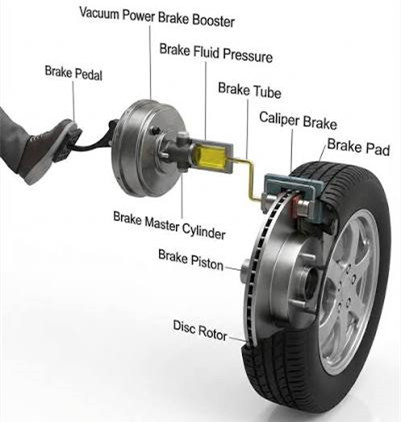
Most passenger car brake systems share a common architecture. The exact components vary by manufacturer and segment, but the following parts show up in almost every disc brake and drum brake assembly.

Disc brake components (front and rear axle)

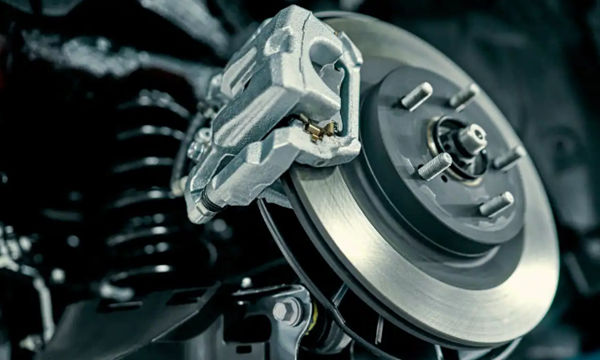
  • Brake disc (rotor): a cast iron or carbon-ceramic disc bolted to the wheel hub. Its two flat friction faces do the actual braking work.
  • Brake caliper: a hydraulically actuated clamp that presses the brake pads against the disc.
  • Brake pads: the friction material that contacts the disc. Composition and geometry are tightly controlled.

Drum brake components (still common on rear axles)

  • Brake drum: a cast iron cylinder that rotates with the wheel. Braking is applied by pressing outward against the inner surface of the drum.
  • Brake shoes: curved friction carriers that press against the inside of the drum.
  • Friction linings: the brake pad material riveted or bonded to the shoes.

Parking brake hardware

  • Parking brake lever (mechanical) or electronic parking brake switch, plus a cable or electronic actuator that applies the rear brakes when the vehicle is stationary. In some designs, the parking brake reuses the service brake pads; in others, it uses a dedicated drum-and-shoe set inside the rotor.

Brake Pad and Brake Disc Materials Used in Production

Material selection drives grinding wheel selection. The four pad families and two disc materials below cover the vast majority of vehicles in production today.

Brake pad material families

  • Semi-metallic pads: 30 to 50 percent steel fibre and iron powder blended with fillers. The dominant production material for entry-level and mid-range vehicles. The standard abrasive tool for grinding this material family is a diamond grinding wheel, with electroplated bond wheels being the most common configuration.
  • NAO (non-asbestos organic) pads: glass fibre, ceramic fibre, and aramid fibre in an organic binder. The grinding wheel of choice remains diamond, with both electroplated and resin bond wheels in widespread use. The resin bond option is often preferred for its elasticity and the lower grinding temperature it produces on softer composite friction surfaces.
  • Ceramic pads: a high-temperature evolution of NAO, with lower dust and quieter operation. Grinding tools mirror the NAO toolset: electroplated and resin bond diamond wheels.
  • Carbon-ceramic pads: high-end material, typically paired with carbon-ceramic discs on performance and luxury vehicles. The abrasive choice is again a diamond grinding wheel, chosen for the very high hardness of the friction surface.

Brake disc material families

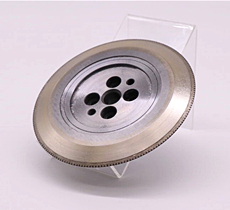
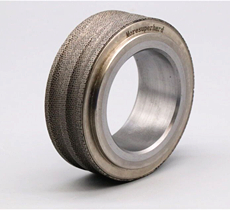
  • Grey cast iron (HT250 grade is the industry default): used in over 95 percent of passenger vehicle brake discs. The standard high-efficiency grinding tool for this material is a CBN grinding wheel. CBN is specifically formulated for ferrous metals, cuts cleanly, controls grinding temperature, and protects the disc surface from thermal damage.
  • Carbon-ceramic discs: a composite of carbon fibre and silicon carbide, produced at temperatures around 1700 degrees Celsius. Conventional abrasives and CBN cannot effectively machine this material. The only production-viable abrasive is synthetic diamond, used in specialised diamond grinding wheels.
More Superhard, a Chinese export manufacturer of superhard abrasive tools, supplies both CBN grinding wheels for cast iron brake discs and diamond grinding wheels for carbon-ceramic discs and for brake pad grinding. Buyers working with the company get wheel specification, dressing recipe, and cycle-time advice as one package.

How Brake Discs Are Ground in Production

Modern brake disc manufacturing combines casting, rough machining, and precision grinding. The grinding step is where final flatness, parallelism, and surface finish are established. A typical high-volume line uses a double-disc grinder with two vertical spindles, one above and one below the disc, grinding both friction faces simultaneously.

Stage 1: Rough grinding

The disc and the grinding wheels rotate in opposite directions at high speed. Most of the stock left from casting and turning is removed, and the disc is brought close to its final geometry. CBN wheels dominate this stage because of their high material removal rate on cast iron and their resistance to wear.

Stage 2: Stress-relief grinding

Rough grinding leaves residual stress in the disc. If the disc goes directly to finishing, the residual stress releases unevenly and the disc warps after machining. In the stress-relief stage, the clamping is reconfigured so that the disc and the wheel rotate in the same direction at slightly different speeds. This operation simultaneously relieves internal stress and brings the disc close to its final thickness.

Stage 3: Finish grinding

The disc is re-clamped, rotated in the opposite direction to the wheel at lower speed, and ground to the final thickness tolerance and surface finish specification. This stage defines the final parallelism between the two friction faces and the final surface roughness, both of which are direct contributors to brake judder, noise, and pad wear.

How Brake Pads Are Ground in Production

Brake pads are made by mixing the friction formulation, hot-pressing it into shape, and heat-treating it. The grinding step that follows is a chain of high-precision operations on an automated line, all targeting the working face and the back plate geometry.

Arc grinding for drum brake shoes

Drum brake shoes have an outer convex face and an inner concave face. Both need precision grinding. The outer arc is ground on a specialised external cylindrical grinder, and the part is then auto-flipped to expose the inner arc, which is ground on a dedicated internal arc grinder.

Flat, slot, and chamfer grinding for disc brake pads

The flat friction face of a disc brake pad is ground, slotted, and chamfered in one cell. A combination diamond wheel can perform slot cutting and chamfering in the same setup, which improves accuracy and reduces cycle time. The slots ground into the pad face are not cosmetic: they evacuate dust, dissipate heat, and reduce brake noise.

How Grinding Wheel Selection Affects Brake Manufacturing

Wheel choice is driven by the workpiece material, the production volume, and the surface finish requirement. The two most important decisions are abrasive type and bond type.

Abrasive: CBN for cast iron, diamond for everything else

Grey cast iron discs are machined with CBN because CBN is chemically stable on iron-group metals and grinds them efficiently at high material removal rates. Carbon-ceramic discs, carbon-ceramic pads, and all organic and semi-metallic pad families are ground with diamond, because the materials being cut are non-ferrous, non-metallic, or both, and diamond is the only abrasive hard enough to cut them economically.

Bond: electroplated versus resin for brake pad grinding

  • Electroplated bond: simple manufacturing process, can be formed into complex profiles for slot and chamfer operations, and rarely needs dressing. The go-to choice for high-volume pad lines where wheel changeover time matters more than surface finish optimisation.
  • Resin bond: slightly elastic, runs cooler, and tends to produce a better surface finish on softer composite friction materials. Often chosen for NAO and ceramic pads where surface finish and pad conditioning matter.

Common Defects in Brake Grinding and How to Prevent Them

  • Disc thickness variation (DTV): caused by wheel wear, dresser wear, or thermal drift. Monitor with on-machine gauging and re-dress on a fixed schedule.
  • Parallelism error: usually a clamping or fixture problem, not a wheel problem. Re-qualify the fixture before replacing the wheel.
  • Pad surface burn: typically a sign of insufficient coolant or too aggressive a cut. Adjust coolant flow before changing wheel specification.
  • Pad chipping at slot edges: the wheel is too hard, or the slot profile is too sharp. Soften the grade and round the slot entry edge.

Frequently Asked Questions

Why are CBN wheels preferred for cast iron brake discs?

CBN does not chemically react with iron at typical grinding temperatures, so it stays sharp on cast iron far longer than aluminium oxide or silicon carbide. The result is higher material removal rate, more stable surface finish, longer wheel life, and lower per-part grinding cost.

Can the same grinding wheel be used for brake discs and brake pads?

Almost never. Brake discs are made of ferrous material (cast iron or carbon-ceramic composite), while brake pads are made of organic or metallic friction composites. The optimal abrasive for the disc is CBN (for cast iron) or diamond (for carbon-ceramic). The optimal abrasive for the pad is diamond. Running a CBN wheel on a non-ferrous pad material wastes wheel life, and running a diamond wheel on cast iron causes rapid chemical wear.

What surface finish is required on a finished brake disc?

Disc surface finish is typically specified in the range of Ra 0.6 to 1.6 micrometres for passenger vehicles, depending on the pad family and the vehicle's NVH targets. Surface finish outside this range correlates with brake judder, squeal, and uneven pad wear.

How long does a CBN grinding wheel last on a brake disc line?

It depends on the disc specification, the material removal rate, the dressing interval, and the coolant setup. In volume production, a single CBN wheel can produce tens of thousands of discs before needing replacement. The economic decision is not just wheel life: it is wheel life multiplied by dressing frequency, multiplied by the cost of machine downtime for wheel changes.

Closing Note from More Superhard

Brake grinding looks simple from the outside, but the abrasive tool has to be matched carefully to the workpiece material, the bond chemistry, the coolant, and the cycle time target. More Superhard works with brake disc and brake pad manufacturers worldwide to specify CBN and diamond grinding wheels that fit a specific production line, not a generic catalogue. Buyers looking for a long-term Chinese partner for superhard abrasive tools can contact the team for wheel samples, dressing recipes, and on-line application support.
 
FOLLOW US
This Blog keeps our valued customers informed of important Radiac News and Events, and in the industries we serve.
Copyright © 2003-2023 More SuperHard Products Co., Ltd
Home
Whatsapp
E-mail
Inquiry