NEWS
03
Jul

Diamond Grinding Wheel for Rubber: How to Beat the Sticky Loading Problem

Share:
Rubber is one of the most useful and most troublesome materials in precision machining. Its elasticity, wear resistance, and damping behaviour make it the default choice for tyres, aerospace seals, printing rollers, vibration mounts, conveyor belts, and dozens of other industrial components. Those same properties, however, turn rubber into a punishing workpiece for any grinding wheel. The chips produced are not the brittle shards you get from metal. They are sticky, elastic, and continuous, and they pack into the wheel surface in seconds. Solving that loading problem is the entire reason that a specialised diamond grinding wheel for rubber exists. This article explains why rubber clogs diamond wheels, what structural and bond features actually solve the problem, and which process parameters make the difference between a clean cut and a burnt workpiece.

Why Rubber Clogs a Diamond Grinding Wheel

A standard grinding wheel cuts by presenting thousands of sharp abrasive grains to the workpiece, each removing a tiny chip. Between the grains, there are pores that act as a chip storage space and as a channel for coolant. With metal, the chips are short, hot, and easily flushed away by coolant. With rubber, the chips are long, sticky, and resistant to flushing. The result is that the pores fill up with rubber, the abrasive grains lose contact with the workpiece, and the wheel becomes a smooth, friction-generating disc that burns the part.
There are two material properties behind this behaviour, and they reinforce each other.
  • High viscoelasticity: under the heat of grinding, rubber softens and partially melts at the contact zone. The chip becomes adhesive rather than brittle, and it bonds to the abrasive grain and to the pore wall on contact. Coolant struggles to remove it.
  • High elasticity: rubber does not fracture cleanly under the abrasive grain. The grain pushes the material rather than cutting it, producing long, continuous chips that wrap around the wheel and pack the pore structure. Once the pores are full, the wheel is dulled instantly, and the grinding zone becomes a pure friction interface.

The Wrong Approach: Finer Grit and Higher Bond Strength

It is tempting to solve rubber loading by switching to a finer grit wheel, on the assumption that a sharper surface will cut more cleanly. In rubber grinding, this is usually the opposite of what works. Finer grit means smaller pore channels, which means the wheel clogs faster. The same logic applies to choosing a harder bond: a hard bond holds the grain in place longer, which sounds durable, but in rubber grinding that just means the dulled grain stays in place and burnishes the workpiece instead of being released to expose a fresh grain underneath.
The correct approach is to redesign the wheel so that the rubber chips have somewhere to go, and so that the bond releases dulled grains on a controlled schedule. Two design features do most of the work.

Design Feature 1: A Large-Pore Structure That Acts as a Chip Reservoir

A high-porosity, large-pore diamond wheel for rubber is built using pore-forming agents in the bond formulation. The result is a three-dimensional network of large, interconnected pores, similar in feel to a hard sponge. Those pores do three jobs at once.
  • They provide physical storage for the sticky rubber chips, so the chips do not sit on the cutting surface.
  • They give coolant a direct path to the cutting zone, so heat is removed at source.
  • The centrifugal force generated as the wheel rotates at speed flings the trapped chips out of the pores, so the wheel self-cleans between parts.
The production impact of a properly designed large-pore structure is dramatic. Lines running on standard rubber-grinding wheels typically need to redress five times per shift. The same line running on a large-pore resin bond diamond wheel often goes an entire shift without a single redressing cycle.

Design Feature 2: A Resin Bond That Releases Grains on Demand

The bond is the material that holds each diamond grain in place. In a standard wheel, the bond is chosen to maximise grain retention and wheel life. In a rubber-grinding diamond wheel, the bond has a different job: it has to release the grain at the right moment, so a fresh grain takes over before the dulled grain starts to burnish the workpiece.
Resin bond diamond wheels are the default choice for rubber for three reasons.
  • The resin matrix has natural elasticity, so the contact between the wheel and the soft rubber workpiece is forgiving rather than aggressive. This reduces the local heat input that drives the rubber into its sticky regime.
  • The bond wears in a controlled way, releasing dulled grains on a predictable schedule. This is the self-sharpening behaviour that keeps the wheel cutting efficiently on soft, gummy materials.
  • Resin bond is well matched to fine surface finish requirements, which are common in rubber roll, seal, and bumper applications.
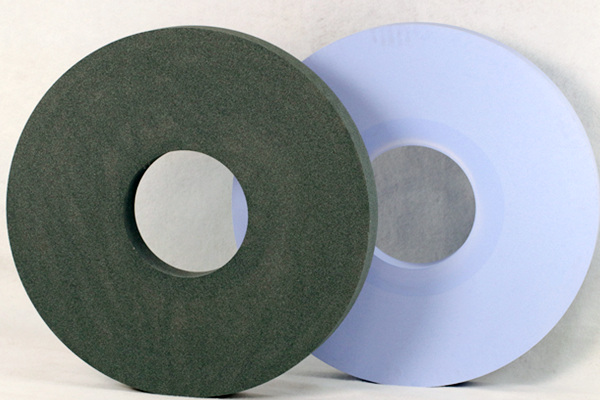
More Superhard produces resin bond diamond grinding wheels specifically engineered for rubber and other soft, sticky materials. The product line covers a wide range of grit sizes, pore structures, and bond hardness levels, all configurable to the customer's workpiece, machine, and cycle time target. As a Chinese export manufacturer, More Superhard supports buyers with wheel selection, dressing recipes, and on-line troubleshooting.

Process Parameters: Cool, Slow, and Steady

A correctly designed diamond wheel for rubber is necessary but not sufficient. The process parameters have to be set in a way that does not push the rubber into its sticky regime in the first place. Three rules cover the vast majority of rubber grinding applications.

Rule 1: Keep the cutting speed moderate

Rubber is a poor thermal conductor. Heat that goes into the workpiece has nowhere to go, and the rubber softens almost immediately above a certain temperature threshold. A high wheel surface speed dumps mechanical energy into the contact zone faster than the coolant can remove it, and the rubber enters its sticky regime. The correct wheel speed is well below the values used for metal grinding, and the exact value depends on the rubber compound and the grit size of the wheel. For typical rubber roll applications, a wheel surface speed in the 20 to 30 m/s range is a sensible starting point.

Rule 2: Find the sweet spot for feed rate

Feed too fast and the chip volume overwhelms the wheel pore structure, causing instant loading. Feed too slow and the abrasive spends too long on each spot, generating friction heat that softens the rubber. The correct feed rate is the value that balances chip volume against thermal input, and it has to be found empirically for each rubber compound and wheel specification. A good starting point is a workpiece speed roughly half of what would be used for an equivalent metal grinding operation, with depth of cut kept light.

Rule 3: Use high-volume, water-based emulsion coolant

Coolant in rubber grinding has to do three things at once: cool the contact zone, lubricate the abrasive-workpiece interface, and physically flush chips out of the wheel pores. A high-volume, water-based emulsion with extreme-pressure additives is the standard choice. The flow rate has to be high enough to physically wash the chips off the wheel surface, and the nozzle has to be positioned so that the coolant hits the contact zone directly rather than running off the wheel body.

Typical Rubber Grinding Applications

  • Rubber rollers for printing, paper, and textile machinery: high surface finish and roundness accuracy are the primary requirements.
  • Automotive rubber components: engine mounts, bushings, and sealing rings where dimensional accuracy directly affects NVH and durability.
  • Aerospace rubber seals: tight tolerances, high reliability, and full traceability of the grinding process.
  • Industrial seals, gaskets, and conveyor belts: high volume, cost-sensitive production runs where wheel life and dressing interval dominate the cost equation.
  • Medical and food-grade rubber components: surface finish and cleanliness dominate, and the wheel has to be free of contaminants that could transfer to the workpiece.

Common Defects in Rubber Grinding and How to Prevent Them

  • Burn marks on the workpiece: usually thermal. Reduce wheel speed, increase coolant flow, or both. Check that the coolant nozzle is aimed at the contact zone.
  • Rough surface finish: usually wheel-related. The grit is too coarse, or the bond is too hard. Check the wheel specification against the rubber compound.
  • Rapid wheel wear: usually the wheel is wrong for the material. Diamond is correct for rubber, but the bond grade and pore structure have to be matched to the specific compound.
  • Dimensional drift across the batch: usually thermal growth in the machine or the workpiece. Allow a warm-up cycle and verify coolant stability before starting the production run.

Frequently Asked Questions

Can a standard diamond grinding wheel grind rubber?

It can, but it will load up almost immediately and either burn the workpiece or stop cutting entirely. Standard wheels are designed for hard, brittle materials, and their pore structure is far too small to evacuate rubber chips. A specialised rubber-grinding wheel with a large-pore resin bond is the production-grade solution.

Why resin bond instead of metal or vitrified bond for rubber?

Resin bond is more elastic than metal or vitrified bond, which matches the elasticity of the rubber workpiece and keeps the contact zone cooler. Resin bond also releases dulled grains on a controlled schedule, which is essential for self-sharpening behaviour on a soft, sticky material.

How long does a rubber-grinding diamond wheel last?

Wheel life is a function of the rubber compound, the grit size, the bond grade, the wheel speed, and the coolant setup. The key metric in production is not total wheel life, but rather the interval between required redressing. A well-specified large-pore resin bond wheel typically lasts an entire shift without redressing on a typical rubber roll line, which is a step change in productivity compared to a standard wheel.

Can the same wheel grind multiple rubber compounds?

It depends on the compounds. Harder rubber compounds, with higher durometer values, can be ground with a slightly harder bond. Softer, stickier compounds require a softer bond and a more open pore structure. For a production line that runs multiple compounds, the best practice is to standardise on a wheel specification that covers the hardest compound, and to adjust process parameters for the softer ones.

What coolant works best for diamond grinding of rubber?

A high-flow, water-based emulsion with extreme-pressure additives. The emulsion has to be clean, well-filtered, and at the concentration recommended by the supplier. Incompatible coolants can degrade the resin bond or react with the rubber, so the coolant selection should be confirmed with the wheel manufacturer.

Closing Note from More Superhard

Rubber grinding is one of those processes where the wheel, the machine, and the process parameters have to be designed as a single system. The right diamond grinding wheel for rubber is built around a large-pore structure and a resin bond that releases grains on demand, and it is paired with moderate cutting speeds, careful feed control, and high-volume coolant. For buyers looking for a long-term Chinese source of rubber-grinding diamond wheels, More Superhard can support wheel selection, sample trials, and on-line application work to get a new line into stable production quickly.
 
FOLLOW US
This Blog keeps our valued customers informed of important Radiac News and Events, and in the industries we serve.
Copyright © 2003-2023 More SuperHard Products Co., Ltd
Home
Whatsapp
E-mail
Inquiry