NEWS
03
Jul

Why Your Grinding Surface Roughness Keeps Fluctuating: A Complete Root-Cause Analysis for Precision Machining

Share:
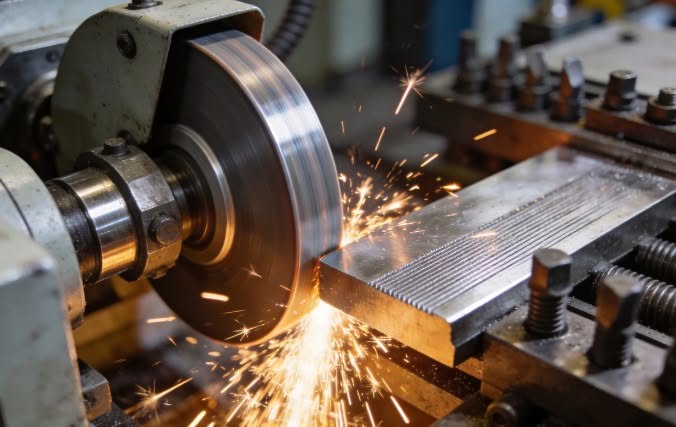
In internal and external cylindrical grinding, surface roughness instability shows up almost the same way on every shop floor: Ra values drift up and down, the workpiece develops a hazy, uneven finish, and there are no visible scratches to explain the rejection pile. The defect is rarely caused by a single factor. It is the combined result of grinding wheel condition, machine vibration, coolant delivery, workpiece fixturing, and process parameters. This article walks through each root cause, then gives a fast on-floor diagnostic method you can apply the next time Ra starts to wander.

How Surface Roughness Fluctuation Actually Happens in Grinding

Surface finish in grinding is determined by the micro-interaction between abrasive grains and the workpiece. Each grain removes a tiny chip, and the height of those chip marks defines Ra. When anything in the grinding loop - the wheel, the machine, the coolant, the part, or the parameter set - drifts, the chip geometry drifts with it, and Ra follows. The most common reason Ra fluctuates batch after batch is that one of these five inputs is unstable.
When you understand the five sources of variation as a closed loop rather than a checklist, troubleshooting becomes much faster. Below, we cover each source in the order of how often it triggers Ra instability in real production environments.

Root Cause 1: Grinding Wheel Condition (The Most Common Trigger)

The grinding wheel is the only component that directly cuts the workpiece. If its dressing quality, sharpness, or structural uniformity is off, every part that touches the wheel will show it. Wheel-related issues account for the majority of surface roughness fluctuation cases seen in production.

Dressing inconsistency and dresser wear

A worn or chipped diamond dresser tip produces a wheel surface with uneven micro-edge heights. When operators run the dresser with non-standard infeed, traverse speed, or spark-out passes, every batch of wheels comes out of dressing with slightly different cutting-edge geometry. The result: Ra numbers that swing up and down across the same production lot.

Progressive wheel dulling and loading

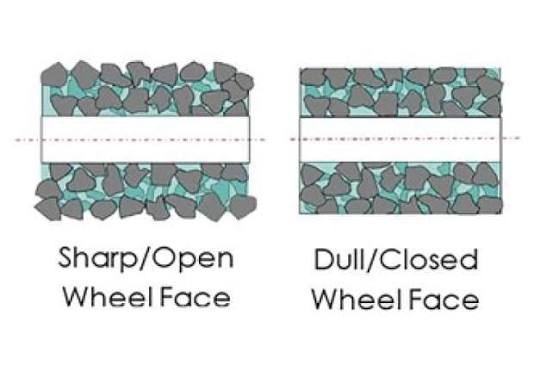
As grinding continues, abrasive grains dull and swarf packs into the pore structure of the wheel. Loaded zones drag against the workpiece and leave a hazy, burnt-looking surface. When dulled grains break loose, the wheel briefly recovers - so the first and last parts in a lot can look like they came from two different machines. This is especially severe on wheels with high grit density and low porosity.

Mismatch between wheel specification and the workpiece

Coarse grit size or excessive abrasive concentration gives a rough cutting texture that is fundamentally incapable of producing low Ra values. Choosing a wheel grade and structure that does not match the material being ground will guarantee poor and inconsistent surface finish, regardless of how well everything else is set up.
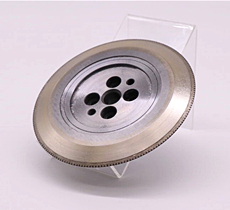
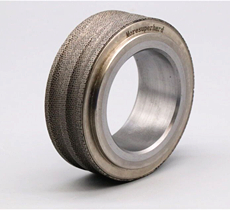
More Superhard supplies vitrified, resin, metal, and electroplated grinding wheels covering CBN, diamond, and conventional abrasives. As a Chinese export manufacturer with deep application know-how, the team helps buyers match wheel specification to workpiece material rather than selling catalogue SKUs.

Root Cause 2: Subtle Machine Vibration (Invisible, but Ra-Destroying)

Some of the most expensive Ra problems do not leave a visible mark. Micro-vibration from the grinding machine imprints fine chatter patterns on the workpiece and pushes Ra numbers up batch after batch. The classic signs are: no scratches, no burns, but Ra just keeps climbing.
  • Excessive spindle bearing clearance, inconsistent belt tension, and runout on the wheel flange all generate micro-vibration at high RPM, which is then copied into the workpiece surface.
  • Loose table-way gib preload causes stick-slip creep at low feed rates, so the actual feed speed becomes unstable even though the dial says otherwise.
  • A weak dressing tool holder allows the dresser to chatter, transferring micro-waviness onto the wheel mother line - and then onto the part.
  • Slender shafts and thin-walled workpieces deflect elastically under grinding pressure; the deflection varies part to part, producing scattered Ra readings.

Root Cause 3: Coolant and Lubrication Supply Problems

Coolant does three jobs at once: cooling, lubrication, and chip flushing. When any of the three breaks down, the workpiece pays the price. Coolant-related issues are the most common cause of sudden surface quality drops mid-shift.
  • A clogged nozzle or unstable supply pressure interrupts the coolant flow at the contact zone. Even a brief dry-out creates a flash of high temperature that plasticises the surface layer, leaving dark haze and a sudden Ra jump.
  • Aged coolant with insufficient filtration carries metal fines back into the contact zone. As the friction coefficient drifts, surface finish drifts with it, and consistency disappears.

Root Cause 4: Workpiece Datum, Stock Variation, and Hardness Spread

Even with a perfect wheel, machine, and coolant, surface roughness can still wander if the workpiece itself is inconsistent. Three datum and material factors cause the majority of variation seen on the shop floor.
  • Inconsistent location datum: burrs in centre holes or locating bores cause runout variation part to part, and that runout imprints itself as surface waviness and Ra drift.
  • Uneven stock allowance from previous operations: the finishing pass sees a varying depth of cut, so cutting force varies, and the resulting surface quality varies too.
  • Hardness spread within a heat-treatment batch: the same parameters cut easy material and hard material differently, producing a noticeable spread in final surface finish.

Root Cause 5: Process Parameter Mistakes

Many Ra fluctuation problems come down to process design rather than equipment. Three parameter mistakes show up again and again in customer reports received by the More Superhard application team.
  • No spark-out pass in the cycle: the elastic recovery of the wheel is not allowed to release, so the final contact pressure on each part is different.
  • Wheel surface speed set too low: this is a particular trap for CBN wheels, which lose cutting ability rapidly at low linear velocity and begin to smear the workpiece.
  • No standardised dressing interval: the wheel is only redressed after Ra has already drifted off-spec, so the production lot is split into a good first half and a bad second half.

Fast On-Floor Diagnostic Method for Surface Roughness Fluctuation

When Ra starts to drift, the fastest way to localise the root cause is to look at the temporal pattern of the bad readings. Each of the five root causes above has a distinctive signature. The following four scenarios cover the majority of cases seen in real production.

Scenario A: First part in a lot is good, later parts drift worse

Signature: progressive deterioration across the same wheel. The cause is almost always wheel dulling and pore loading, combined with a dressing interval that is too long for the material being ground. Shorten the dressing cycle and check that the dresser is sharp.

Scenario B: Ra values scatter randomly part to part

Signature: no temporal pattern, just noise. Look for micro-vibration from the spindle, drives, or dresser, and for fixturing runout on the workpiece. These are usually mechanical issues rather than wheel issues.

Scenario C: Finish drops mid-shift, recovers after a stop

Signature: thermal pattern. Coolant is not reaching the contact zone in sufficient volume, the workpiece is heat-stacking, and the surface is plasticising. Inspect nozzle condition, supply pressure, and filtration.

Scenario D: First part after dressing is good, then Ra drops after a few parts

Signature: dressing process itself is unstable. The dresser is worn, the dressing parameters are not standardised, or the dresser holder is flexing. Replace or recondition the dresser and lock the dressing recipe.

How to Lock Surface Roughness Stability Long Term

Fixing the immediate problem is only half the job. To keep Ra stable shift after shift, the most effective production teams standardise four things.
  • Wheel specification: a small set of validated wheel SKUs matched to each workpiece material, with documented grit, grade, structure, and bond.
  • Dressing recipe: a written procedure covering dresser type, infeed, traverse, and spark-out count, repeated the same way for every batch.
  • Process parameters: locked values for wheel speed, work speed, depth of cut, and spark-out, with clear change-control rules for any deviation.
  • Coolant management: scheduled concentration checks, filtration checks, and nozzle inspection, logged at fixed intervals.

Frequently Asked Questions

What Ra value is realistic for cylindrical grinding of hardened steel?

For conventional abrasive wheels, Ra 0.4 to 0.8 micrometres is a realistic production range on hardened steel. With CBN wheels and a properly dressed wheel, Ra 0.2 to 0.4 micrometres is achievable in volume production. Hitting Ra below 0.1 micrometres usually requires superfinishing as a separate operation.

How often should I redress a grinding wheel in production?

There is no universal interval. The right cadence depends on workpiece hardness, material removal rate, wheel specification, and dressing aggressiveness. The correct method is to measure Ra during production and set the dressing interval to retrigger well before Ra drifts off-spec, not after.

Can the wrong coolant cause Ra fluctuation even with a fresh wheel?

Yes. Coolant concentration, filtration grade, and nozzle condition all directly affect surface finish. A clean, fresh wheel will still produce drifting Ra if coolant delivery is unstable or the fluid is contaminated. Coolant is part of the grinding system, not an accessory.

When should I switch from a conventional wheel to CBN?

For ferrous materials, especially hardened steels above HRC 55 and cast irons, CBN wheels typically deliver longer wheel life, more stable Ra, and lower grinding temperature. The economic crossover usually appears when batch sizes are large enough that wheel changeover and dressing downtime become a significant cost driver.

Closing Note from More Superhard

Surface roughness fluctuation is almost never a single-cause problem. The fastest path to stable Ra is to treat the wheel, the machine, the coolant, the workpiece, and the parameters as one closed loop, and to standardise the parts of that loop that you control. For buyers sourcing grinding wheels internationally, working with a manufacturer who can support wheel selection, dressing recipe, and process parameters together - rather than ship a catalogue SKU - is usually the shortest route to stable, repeatable surface finish.
FOLLOW US
This Blog keeps our valued customers informed of important Radiac News and Events, and in the industries we serve.
Copyright © 2003-2023 More SuperHard Products Co., Ltd
Home
Whatsapp
E-mail
Inquiry