NEWS
21
Sep

Dual Diamond Wheels for a Robotic Grinding Cell in Israel

Share:
Robotic grinding cells are spreading fast across metalworking shops that want consistent deburring, edge breaking and surface conditioning without tying skilled workers to repetitive manual grinding. But a robot is only as good as the tool on its wrist — and off-the-shelf grinders rarely match the exact wheel sizes, speeds and duty cycles a cell demands. This case study walks through a real project: an Israeli long-term customer of More Superhard needed a grinder that could carry two different diamond wheels on a single spindle and run ten hours a day inside a robot cell. Here is how our engineering team designed, validated and delivered the solution, and what it means for your own automation project.


The Customer's Challenge: A Robot Cell That Needed the Right Grinder


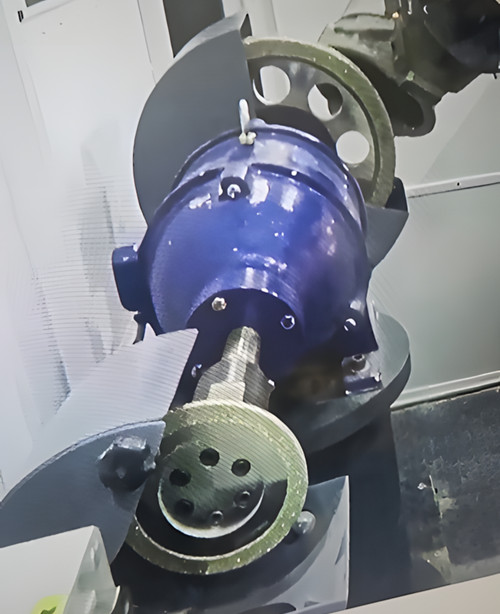
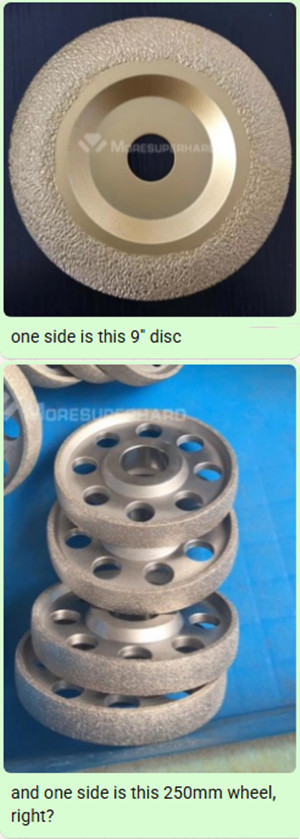
The customer, an established industrial manufacturer from Israel that has worked with More Superhard for years, was building an automated grinding station around an industrial robot arm. Their existing approach — a fixed grinder with a single wheel — could not cover two distinct operations in one cycle. They needed one tool head that could mount a 9-inch brazed diamond grinding disc on one side and a 250 mm perforated grinding wheel on the other, so the robot could switch between coarse stock removal and finer finishing moves without a manual wheel change.
Because the station was designed for heavy daily use — ten hours of grinding per day — every component had to survive continuous duty: the motor, the bearings, the wheel mounting, and even the dust extraction. The customer also asked for the base frame and the dust collection duct to be supplied together with the grinder, turning the order into a complete working station rather than a bare machine.


What the Customer Needed: The Full Requirement List


Before any design work started, our engineers confirmed the requirement list line by line with the customer:
  • One grinder head mounted on the robot arm, carrying two wheels on a shared spindle
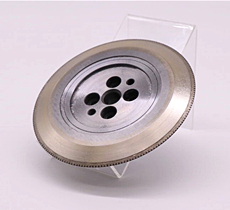
  • Side A: a 9-inch (230 mm) brazed diamond grinding disc
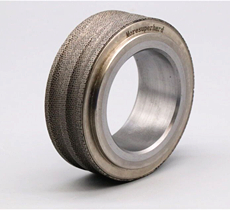
  • Side B: a 250 mm diamond grinding wheel with mounting holes
  • Center shaft length of approximately 400 mm between the two wheels
  • Base frame supplied by More Superhard
  • Dust extraction duct supplied with the machine
  • Duty cycle: 10 hours of operation per day
With the specification locked, the real engineering question emerged: could a standard direct-drive grinder run these diamond wheels safely — or did the motor need to be re-engineered?


Engineering the Solution: A Direct-Drive Grinder, Modified for Diamond


The grinder in the customer's original video reference was a direct-drive model — the wheel mounts straight on the motor shaft, with no belt transmission. That architecture is compact and stiff, which suits robot mounting. However, belt-drive grinders, which are usually larger and heavier, did not fit the robot payload and space envelope at all, so direct drive was the only viable path.
The catch: a standard grinder motor is dimensioned for conventional abrasives. Diamond wheels behave differently, and the combination of wheel diameter, working speed and available spindle rpm had to be checked against the physics of wheel peripheral speed.


Why Peripheral Speed Matters: The 80 m/s Rule


Diamond grinding wheels carry a rated maximum peripheral (surface) speed — for the wheels in this project, 80 m/s. To use a wheel comfortably and productively, the spindle speed must bring the wheel's working surface close to its rated speed band. The math is simple but unforgiving:
  • A 9-inch (230 mm) disc at 80 m/s needs roughly 6,600 rpm
  • A 250 mm wheel at 80 m/s needs roughly 6,100 rpm
  • The standard direct-drive motor delivers 2,850 rpm at 50 Hz and 3,400 rpm at 60 Hz
In other words, the stock motor runs well below the ideal speed band for these wheels. Running a 250 mm diamond wheel at 2,850 rpm is acceptable — the wheel simply wears somewhat faster than it would at full rated speed — but it is a compromise that had to be discussed openly with the customer.


The VFD Question: More Speed vs. Bearing Life


One obvious fix is a variable frequency drive (VFD), which can push the motor beyond 50/60 Hz and raise spindle speed toward the 4,000+ rpm range these wheels prefer. Our engineers explained the trade-off honestly: over-speeding a standard grinder motor with a VFD significantly shortens bearing life, because the bearings were not specified for continuous high-rpm duty. For a machine grinding ten hours a day, bearing failure would mean unplanned downtime — the opposite of what an automation cell needs.
The agreed conclusion: keep the wheel diameter at or below 250 mm, accept the standard 2,850 rpm at 50 Hz, and plan for slightly faster wheel wear instead of risking the spindle. There was also a practical acoustic limit — perforated diamond wheels running at excessive speed can generate a high-pitched whine, another reason not to chase rpm blindly.


Answering the Hard Questions: Force Compensation


Midway through the project the customer asked a sharp question: does the grinder come with a flexible grinding-force compensation mechanism? It is the kind of question that separates real automation experience from guesswork, so here is the answer we gave — useful for anyone planning a robotic grinding cell.


Compensation Belongs to the Robot, Not the Grinder


Grinding-force compliance is normally implemented in the robot program, not inside the grinder. In this cell, the robot trajectory is pre-set to remove only the planned excess material or burr, and the program allows the arm — and with it the wheel — to back off automatically when the measured force gets too high. That back-off behavior is the safety mechanism: if the wheel position were perfectly rigid and the part position varied even slightly, a rigid cell could crash or gouge the workpiece.
The customer should confirm this function with their robot integrator, because it lives in the robot controller software. More Superhard's role is to deliver a grinder and wheels that behave predictably when forces change — which leads to the second half of the answer.


Diamond Wheels Need Far Less Compensation Than You Think


Conventional ceramic grinding wheels wear quickly and change diameter continuously, which is why many cells need constant force compensation to keep results stable. Diamond and CBN superabrasives are different: their wear over a wheel's life is typically only fractions of a millimeter. That dimensional stability means the grinding geometry stays nearly constant shift after shift, so the cell does not rely on heavy compensation to hold quality. For this customer, running without a compensation mechanism on the grinder itself was confirmed to be completely acceptable.


Installation Details Worth Confirming Early


Two installation dimensions were finalized early to avoid surprises on the factory floor:
  • Spindle center height: standard approximately 900 mm from the floor, confirmed acceptable by the customer
  • Dust extraction duct diameter: standard 110–120 mm, matched to the customer's extraction system
Small numbers like these are exactly where integration projects stall if nobody asks early — so we ask early, on every project.


Why Partner with More Superhard for Robotic Grinding Projects


This project was not simply a grinder sale. More Superhard acted as an engineering partner: sourcing the right machine base from vetted suppliers, modifying the motor specification for diamond wheels, supplying the wheels themselves — brazed diamond discs and perforated diamond wheels are core products of our own factory — and standing behind the integration details from spindle height to dust ducts.
As a China-based manufacturer and exporter of superabrasive tools and grinding equipment, More Superhard (Mo'ao Superhard) combines in-house wheel production with hands-on application engineering. That combination matters when a robot cell needs more than a catalog item: it needs someone who understands both the abrasive and the machine holding it.


Key Takeaways for Your Own Robot Grinding Cell

 
  • Match the wheel's rated peripheral speed to the spindle's real rpm before ordering — don't assume a stock motor fits diamond wheels
  • A VFD can add speed, but bearing life may pay the price on heavy-duty cycles
  • Force compliance is usually a robot-program function; superabrasive wheels need less of it than ceramic wheels
  • Lock integration dimensions early: spindle height, duct diameter, mounting interface, duty cycle
  • Buy the wheel and the grinder from one responsible partner to avoid blame-shifting at integration time


Frequently Asked Questions


Can a standard grinder run diamond wheels?
Sometimes, but not automatically. Diamond wheels have rated peripheral speeds that often exceed what a standard motor delivers at 50/60 Hz. Check wheel diameter, rated speed and spindle rpm together — and expect a trade-off between wheel wear and bearing life if you over-speed with a VFD.

Does the grinder need grinding-force compensation?
Usually no. In robot cells, compliance is implemented in the robot program, which backs the arm off when force spikes. Diamond and CBN wheels wear only fractions of a millimeter over their life, so process geometry stays stable without constant compensation.

What wheel size works on a direct-drive grinder?
For standard 2,850 rpm (50 Hz) direct-drive motors, wheels up to about 250 mm are a practical match. Larger diameters drop surface speed further or require higher rpm, which stresses bearings.

Can More Superhard supply the complete station?

Yes. We supplied the grinder, both diamond wheels, the base frame and the dust extraction duct as one package, and we confirm installation dimensions with the integrator before shipment.


Talk to Us About Your Grinding Automation Project


If you are planning a robotic grinding or deburring cell and need a grinder engineered around your wheels — not the other way around — More Superhard is ready to help. Send us your wheel sizes, duty cycle and robot payload, and our application engineers will propose the motor specification, wheel selection and mounting layout for your cell.
Contact More Superhard today for a technical consultation and quotation — from single wheels to complete robot-ready grinding stations.
 
FOLLOW US
This Blog keeps our valued customers informed of important Radiac News and Events, and in the industries we serve.
Copyright © 2003-2023 More SuperHard Products Co., Ltd
Home
Whatsapp
E-mail
Inquiry