From September 9 to 11, 2026, More Superhard's grinding and polishing team attended the China International Optoelectronic Expo (CIOE 2026) at the Shenzhen World Exhibition & Convention Center in Bao'an. For the first time, CIOE was held alongside the International Integrated Circuit Innovation Expo (IICIE) and elexcon Shenzhen, creating a combined exhibition of 320,000 m², more than 5,000 exhibitors and nearly 190,000 visitors — a 32% increase year on year. This year's show was organized around "AI + optoelectronics," spanning information communication, precision optics and cameras, lasers and intelligent manufacturing, infrared, smart sensing and new displays.
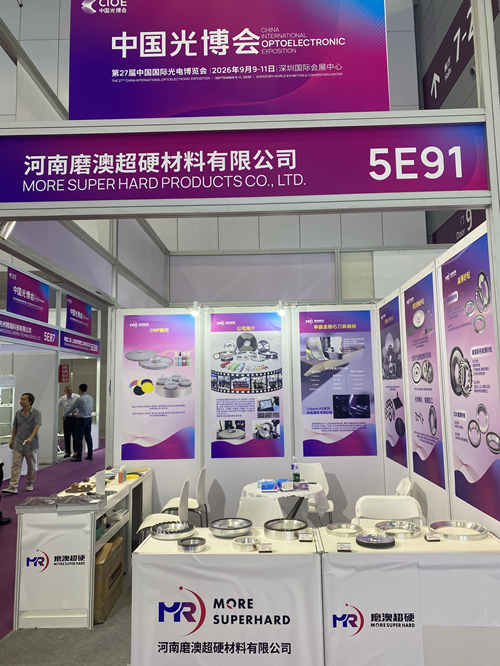
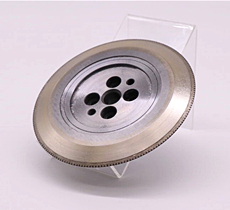
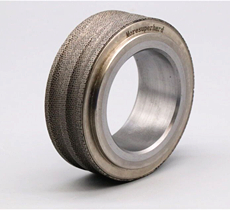
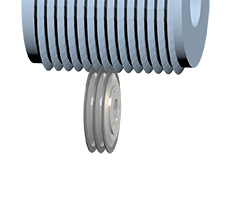
On the More Superhard booth, the team presented resin- and metal-bonded diamond cutting blades, diamond lapping compounds, polishing pads, wafer backgrinding wheels and grinding heads, together with application support for cutting, grinding and polishing. Customer conversations were concentrated in four segments: optical component manufacturers, semiconductor packaging and wafer fabs, optical equipment builders, and robot-plus-flexible-line integrators.
Three signals stood out for anyone involved in grinding machines and abrasives. First, the grinding and polishing link is moving from single machines to packaged machine-consumable-process solutions. Second, buyers increasingly purchase consumables and process know-how together rather than individual items, and they weigh surface yield, consumable life, consistency and customization. Third, the products that drew the most qualified inquiries were dicing blades, polishing pads and backgrinding wheels.
2 Industry trends every grinding and polishing buyer should watch
2.1 Localization of optical machine tools opens a substitution window for domestic wheels
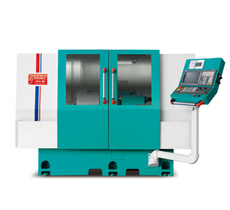
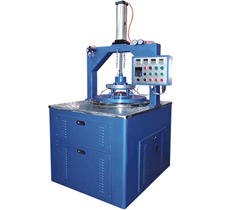
HOYA's processing center drew steady crowds, a reminder that the most demanding optical production still relies mainly on Japanese and Korean equipment. At the same time, localization is clearly advancing: Beijing RK's CNC flat milling machines, ring polishers and three-axis lapping/polishing machines now cover rough milling, fine milling and polishing of optical elements, and their demand for matching consumables — metal-bonded diamond wheels, electroplated wheels and CBN wheels — is ramping up quickly.
The substitution window matters for abrasive suppliers: as more domestic machines enter optical shops, wheel specifications, delivery cycles and process support become the deciding factors for winning contracts.
2.2 Precision grinding and polishing fuse into single processes
The biggest highlight of the precision optics halls was process fusion. Multiple exhibitors showed "milling + polishing" compound machines that compress several conventional operations into one, pushing consumables toward higher stability, longer life and mirror finishes. Equipment makers increasingly supply matched wheels for their own machines, especially on optical milling machines and double-side lapping machines.
2.3 Robot-driven flexible grinding and polishing lines become mainstream
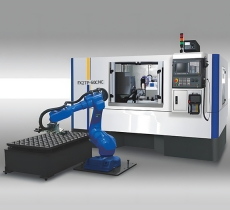
Several robot-plus-grinding lines were on display, with ABB, KUKA and FANUC teaming up with polishing equipment makers. Tinbin Optoelectronics (Shanghai) showed an ABB robot integrated with an XBZN-1000 intelligent robot polishing machine. For consumable suppliers, this shifts procurement from piece-by-piece buying to line-level packaging, raising the bar on specification standardization, fast delivery and stable supply.
2.4 Market data: superhard wheels grow faster than the general market
According to industry research cited in the company's exhibition report, the global grinding wheel market was worth about US$4.9 billion in 2025 and is projected to reach about US$5.9 billion by 2032 (CAGR ≈ 2.7%), with China holding more than 40% of the world market. The diamond grinding wheel segment grew from US$706 million in 2017 to US$1.115 billion in 2025 (CAGR ≈ 6% globally), while China's diamond wheel market expanded from ¥1.101 billion to ¥2.227 billion (CAGR ≈ 9.2%). The high-end segment — wheels priced at ¥200 or more per piece — reached ¥4.12 billion in 2025 and is expected to exceed ¥5.2 billion in 2026, about 38.5% of the industry. These figures point in one direction: high precision, customization and specialization, not scale alone, now drive growth.
2.5 AI and optoelectronics reshape downstream demand
The show's core theme was "AI + optoelectronics." With 800G optical modules still the main shipping volume and 1.6T modules entering small-batch delivery, demand is moving upstream to optical chips, fibers and test equipment — all of which require precision grinding, lapping and polishing, such as MPO connector and MT ferrule end-face polishing. Meanwhile, 3D + AI machine vision was presented for precision inspection, a direction that can also be applied to grinding-wheel dressing and profile inspection in process control.
3 Grinding machine know-how: solving the most common floor problems
Across the three show days, the most frequently asked-about products were dicing/cutting blades, polishing pads and backgrinding wheels. The following field problems and selection points were repeatedly raised by customers.
3.1 Why do ultra-thin dicing blades crack when cutting ceramics?
Cutting-blade cracking was the most common complaint among customers cutting zirconia, functional ceramics and optical glass. On the floor, four causes came up repeatedly:
- Selection mismatch: if bond hardness and diamond grit do not match the workpiece, cutting resistance rises sharply and the thin blade base develops radial cracks under alternating stress.
- Process parameters: excessive feed rate, spindle speed outside the rated range, lateral runout and insufficient cooling cause thermal shock cracks. Brittle ceramics cannot deform plastically, so stress converts directly into blade and workpiece cracks.
- Blade structure and handling: ultra-thin blades have weak torsion resistance; small bumps during handling or mounting create invisible micro-cracks that grow under load.
- Machine condition: high spindle runout and poor clamping cause continuous vibration and impact on the blade.
3.2 Backgrinding wheels on SiC: why teeth break and wear fast
SiC has a Mohs hardness of 9.5, extremely high hardness and low fracture toughness, so grinding generates large impact loads. Tooth roots are stress concentration points, which is where chipping and tooth breakage typically start. Bond selection is a balancing act: a bond that is too hard stops self-sharpening — the wheel dulls and grinding force spikes, breaking teeth — while a bond that is too soft sheds grit too early and wears quickly. Excessive infeed and insufficient coolant cause thermal fatigue at the tooth. Sapphire substrate thinning was one of the fastest-growing inquiries at the show.
3.3 Diamond lapping compounds: match grit to the process stage
Diamond lapping compounds cover a grit range of about 0.2–40 μm in water-based and oil-based systems. D50 is the key control: larger grit removes material faster but risks deeper scratches; finer grit improves surface finish at lower efficiency. A typical route is coarse lapping with 3–40 μm aggregated diamond (for example DL4045 at 40 μm for sapphire rough lapping), fine lapping at 1–1.5 μm (for example DL1532) for micron-level roughness, and a 0.2–0.5 μm pre-polishing step to reduce subsurface damage before CMP. Strict particle size distribution control is essential for brittle semiconductors and ceramics — oversize particles cause deep scratches and yield loss. Store compounds above 0 °C to prevent freezing and agglomeration.
3.4 Polishing pads: hard for stock removal, soft for final finish
Pad hardness, groove structure and porosity determine removal rate, surface roughness and chip evacuation. Hard honeycomb or polyurethane pads deliver high local pressure and removal efficiency for rough lapping of SiC and sapphire; honeycomb or grid grooves help evacuate swarf and reduce scratching. Soft non-woven pads conform to the workpiece and suit CMP final polishing for ultra-low Ra. The practical selection logic is simple: a hard pad for stock removal, a soft pad for finish, and grooved pads for ceramics and semiconductors to avoid re-scratching.
4 New processing methods on show
4.1 Milling + polishing compound machines
Dual-spindle optical milling centers — such as the HCG50 with six-axis, five-axis-linkage control — can complete rough and fine grinding of optical elements in a single clamping, tightening requirements on wheel grade consistency, balance and dressing accuracy. Glass ball lapping machines with hydraulic pressurization, structurally similar to bearing ball grinding machines, were also demonstrated.
4.2 Ultra-precision aspheric machining
Ultra-precision compound machine tools such as the UPN150 series target mass production of aspheric molds and hard-brittle parts — tungsten carbide mold inserts, sleeves and ceramic sleeves — with form accuracy PV under 0.15 μm, surface roughness Ra under 5 nm and inner/outer roundness down to 0.1 μm. These machines set a new bar for grinding wheel runout, balance and dressing precision.
4.3 Magnetic-fluid and CMP polishing
Magnetic-fluid (magnetorheological) polishing was highlighted as an ultra-precision surface process that demands highly uniform abrasive particles. CMP polishing machines and CMP dressers were widely shown, paired with polyurethane, non-woven and damping-cloth pad families, and diamond lapping pads for fixed-abrasive processing.
4.4 Large double-side lapping for wafers
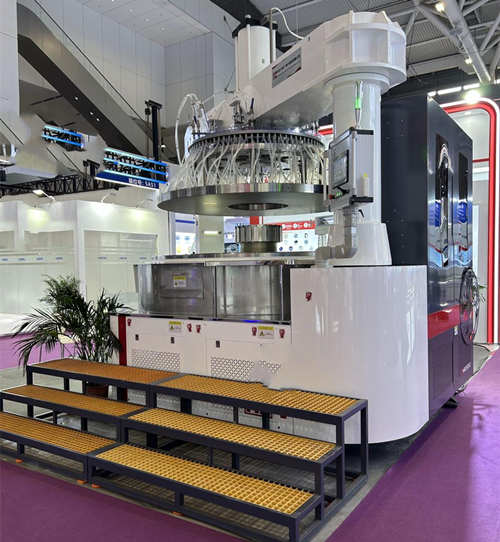
Double-side lapping machines now take polishing pads up to 2.2 m in diameter — typically four spliced pieces — and can polish up to 20 pieces of 12-inch wafers in a single run. This scale pushes pad flatness, groove uniformity and batch consistency to new limits, and directly raises demand for precision dressing wheels and matched consumables.
5 New opportunities for grinding and polishing
- Semiconductor: wafer thinning and backgrinding (SiC, silicon), chamfering and dicing remain the fastest-moving demand; sapphire substrate thinning consumables are rising quickly. Ceramic-bonded diamond wheels for wafer thinning and resin-bonded wheels for optical glass are both in the growth curve.
- Precision optics: as domestic machine tools localize, the opportunity shifts to supplying complete consumable kits and process support for glass lenses, prisms, sapphire covers and ceramic optics.
- Optical communications: fiber end-face polishing for MPO connectors, MT ferrules and PIN pins is a hot application, with strong demand reported from Malaysia, Pakistan, India, Spain, Jordan, South Korea, Turkey, Thailand, Egypt and Russia.
- Automotive and robotics: vehicle-grade cameras, LiDAR components and robot joint bearings raise demand for precision grinding, matched by the rising penetration of diamond and CBN wheels in bearing, gear and hard-part machining.
- From products to process definition: leading users and suppliers are moving from "supplying products" to "defining processes" — through joint laboratories, grinding databases and co-developed solutions. Low-temperature vitrified bonds and microcrystalline abrasives are improving self-sharpening, efficiency and precision control.
6 FAQ
6.1 What is the difference between resin-bonded and metal-bonded diamond grinding wheels?
Resin-bonded wheels generally provide better surface finish and lower grinding force, which suits optical glass and mirror-finish operations. Metal-bonded wheels hold grit longer and handle higher stock removal on hard, brittle materials such as ceramics, sapphire and SiC; they are a common choice for optical milling and backgrinding.
6.2 Which wheel should I use for optical milling?
Electroplated and metal-bonded diamond wheels are the standard choices on optical milling machines. Selection depends on the workpiece material, stock removal per pass and edge-retention requirements; wheel consistency and dressing accuracy matter as much as the bond type.
6.3 What grit of diamond lapping compound is right for sapphire roughing?
For sapphire rough lapping, use coarse aggregated diamond around 3–40 μm (for example 40 μm for fast stock removal), then fine-lap at 1–1.5 μm, then apply a 0.2–0.5 μm pre-polish to reduce subsurface damage before final CMP.
6.4 Why do my dicing blades crack on ceramics?
Check four things in order: bond and grit matching to the workpiece, feed rate and spindle speed, cooling, and blade handling plus spindle runout and clamping. One or more of these is usually the root cause; brittle ceramics transfer stress directly into cracks.6.5 Hard or soft polishing pad for CMP?
Soft non-woven pads are typically used for CMP final polishing to reach ultra-low Ra, while hard grooved (honeycomb or grid) pads are for the rough lapping stages where removal rate comes first.
6.5 How fast is China's diamond grinding wheel market growing?
Per industry research cited in our exhibition report, China's diamond grinding wheel market grew at about 9.2% CAGR from 2017 to 2025, faster than the roughly 6% global CAGR for diamond wheels, and the high-end segment (wheels at ¥200 or more per piece) is growing fastest.
Sources: Based on the CIOE 2026 exhibition reports of More Superhard's grinding and polishing team (Shenzhen, September 9–11, 2026), including on-site observation, exhibitor materials and customer interviews. Market figures are as cited in those reports from industry research. Verified: September 21, 2026.

.jpg)