NEWS
29
Aug

Sintered Diamond Cutting Discs for Ceramic Green Body Machining: A Complete Technical Guide

Share:

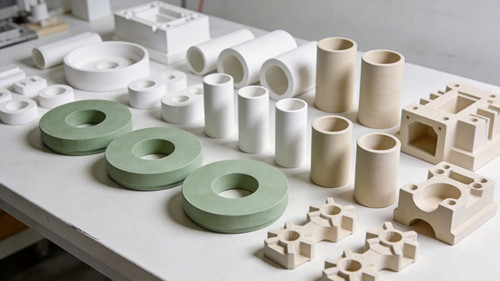
In the production of advanced ceramics, electronic ceramics, structural ceramics, and precision ceramic components, green body machining is a critical yet often overlooked stage. Ceramic green bodies — the pre-sintered compacted forms — present unique machining challenges that distinguish them from both raw metals and fully sintered ceramics.

                            Sintered Diamond Cutting Discs for Ceramic Green Body Machining:


Unlike sintered ceramics, green bodies have relatively low strength but contain large quantities of hard ceramic powder particles. This combination of low structural integrity with high abrasive content creates a material that is hard yet brittle, prone to edge chipping, dust generation, deformation, and dimensional instability during machining.

Sintered diamond cutting discs offer an effective solution for these challenges, combining the extreme hardness of diamond with the durability of a sintered metal bond to deliver efficient, precise, and consistent machining of ceramic green bodies.

What Is a Ceramic Green Body?


A ceramic green body is the formed but unsintered compact created after ceramic powder undergoes mixing, pressing, injection molding, or other forming processes. At this stage, the material consists of ceramic powder particles held together by organic or inorganic binders, plasticizers, and forming aids.
While green bodies have not yet achieved the full hardness and density of sintered ceramics, the ceramic particles themselves — whether alumina (Al2O3), zirconia (ZrO2), silicon nitride (Si3N4), or silicon carbide (SiC) — retain their inherent hardness. This means green body machining is not simply cutting soft material; it requires tools that can handle abrasive, hard particulates while managing the fragile bond structure.
In precision ceramic component manufacturing, green body machining must simultaneously address material removal rate, tool wear, dimensional accuracy, and edge integrity — making tool selection a critical process decision.

Why Diamond Is the Ideal Abrasive for Green Body Machining


Diamond offers exceptional hardness and wear resistance, making it one of the most effective superabrasive materials for machining ceramic materials. For green bodies containing alumina, zirconia, silicon nitride, silicon carbide, and other hard ceramic particles, conventional abrasives wear too quickly to maintain dimensional accuracy and surface quality.
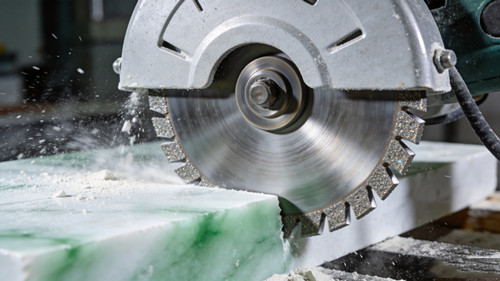
Diamond tools can handle a wide range of green body machining operations including external diameter grinding, internal bore machining, slot cutting, chamfering, edge trimming, surface grinding, profile machining, and precision dimensioning. For batch production requiring high dimensional consistency, diamond tools offer significant advantages over conventional alternatives.
 

Advantages of Sintered Diamond Tools for Green Body Machining


                          Sintered Diamond Cutting Discs for Ceramic Green Body Machining:

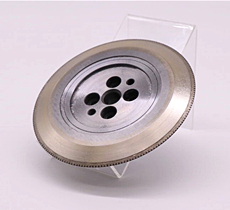
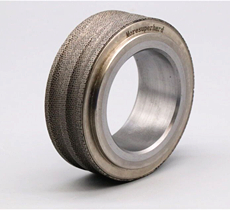
Sintered diamond tools, produced through high-temperature, high-pressure sintering processes that embed diamond grit within a metal or ceramic bond matrix, offer several key advantages for ceramic green body machining:
  • Superior wear resistance: The high hardness and wear resistance of diamond significantly extends tool life, particularly important for continuous machining of abrasive ceramic materials. This reduces tool change frequency and improves production consistency.
  • High machining efficiency: Properly designed diamond grit size, concentration, and bond composition maintain good cutting sharpness while achieving high material removal rates. This reduces per-part machining time without sacrificing edge quality.
  • Excellent dimensional consistency: The stable diamond working layer minimizes tool dimension changes during machining, maintaining tight tolerances across production batches — essential for ceramic parts that must meet precise specifications before sintering shrinkage.
  • Versatile form factors: Sintered diamond tools can be designed as grinding wheels, grinding heads, dressing tools, form wheels, and cutting tools, enabling machining of complex features including holes, slots, chamfers, and custom profiles on green body components.

Critical Factors in Diamond Tool Selection


Selecting the right diamond tool for green body machining involves more than choosing the hardest option available. The key factors that determine machining performance include diamond grit size, diamond concentration, bond type, tool structure, and machining parameters.
Grit size directly affects both machining efficiency and surface quality. Coarser diamond grit provides higher material removal rates suitable for roughing operations, while finer grit delivers better surface finish and dimensional precision for finishing passes. A staged approach — coarse grit for roughing, medium for semi-finishing, and fine for finishing — optimizes the overall process.
Diamond concentration must be balanced carefully. Too low a concentration leads to insufficient cutting capacity and rapid tool wear. Too high a concentration reduces cutting sharpness and increases machining forces, potentially damaging the fragile green body. The optimal concentration depends on the specific ceramic material, machining allowance, and equipment power.
Bond selection is equally important. For applications prioritizing sharpness and self-sharpening behavior, resin bond systems may be preferred. For maximum tool life and dimensional stability, metal bond systems offer superior grain retention. The final selection should be validated through trial machining under actual production conditions.

Why Green Bodies Are Prone to Chipping and Dusting


Edge chipping and dust generation are the most common quality issues in green body machining. These problems stem from the fundamental nature of the green body structure: ceramic particles that have not yet been bonded through high-temperature sintering, relying instead on relatively weak binder bridges for structural cohesion.
Aggressive machining parameters — excessive depth of cut, high feed rates, dull tools, inappropriate grit size, or insufficient coolant — all increase the localized forces on the green body. When these forces exceed the binder bridge strength, the result is edge chipping, subsurface cracking, dust generation, dimensional overshoot, or in severe cases, complete workpiece breakage.
The solution lies in adopting a sharp, stable, low-impact machining philosophy. Diamond tools should be selected and operated to minimize cutting forces while maintaining efficient material removal — a balance that requires careful attention to all the tool and process parameters discussed above.

The Harder-Is-Not-Always-Better Principle


One of the most important insights in green body machining is that diamond tool performance depends on the balance between grain retention and self-sharpening, not simply on maximizing hardness or bond strength.
If the bond holds diamond grains too tightly, dulled grains remain in the tool face instead of being replaced by fresh, sharp grains. This leads to increasing cutting forces, elevated temperatures, degraded surface quality, and reduced machining efficiency.
Conversely, if the bond is too soft, diamond grains are released prematurely, shortening tool life and increasing cost per part. The optimal bond design achieves a controlled wear rate where dulled grains release at the right moment to expose fresh cutting edges — maintaining consistent performance throughout the tool life.

From Green Body to Finished Ceramic: Optimizing the Full Process


Ceramic component manufacturing follows a well-defined sequence: powder preparation, forming, green body, green machining, debinding, sintering, finish machining, and final inspection. Green body machining and post-sinter finish machining serve different purposes and should be strategically allocated.
The advantage of green body machining is that material removal is easier and faster due to the lower strength of the unsintered material. By performing as much machining as possible at the green stage — particularly complex features, large material removal, and roughing operations — manufacturers can reduce the more difficult and expensive post-sinter machining to only final dimensioning and surface finishing.
This strategic allocation, enabled by high-performance sintered diamond tools, reduces overall manufacturing cost and cycle time while maintaining the quality requirements of the finished ceramic component.

The Shift Toward Customized Diamond Tool Solutions


No single diamond tool specification can address all ceramic green body machining requirements. Different ceramic materials, part geometries, equipment configurations, and production volumes demand tailored solutions.
Modern diamond tool suppliers work closely with ceramic manufacturers to develop application-specific tool designs. Parameters such as material type, workpiece dimensions, machine model, spindle speed, machining method, stock allowance, surface roughness requirements, and production rate targets all inform the tool specification.
The industry is evolving from a buy a standard specification mindset toward a design the right tool for the application approach — and this shift is delivering measurable improvements in machining performance, tool life, and cost per part across the advanced ceramics sector.

Conclusion


Ceramic green body machining may appear simpler than machining fully sintered ceramics, but it demands precise attention to tool sharpness, stability, and parameter optimization. Sintered diamond tools, with their exceptional hardness and wear resistance, provide an effective platform for achieving the balance between machining efficiency, tool life, dimensional accuracy, and edge quality.
MoreSuperHard offers a comprehensive range of sintered diamond cutting discs and grinding tools designed for advanced ceramic applications. Our technical team works with customers to match tool specifications to specific materials and machining conditions, ensuring optimal performance from the very first pass.

Get in Touch


Need customized diamond tooling for your ceramic manufacturing process?
Contact MoreSuperHard today for customized solutions tailored to your specific grinding and machining needs.
FOLLOW US
This Blog keeps our valued customers informed of important Radiac News and Events, and in the industries we serve.
Copyright © 2003-2023 More SuperHard Products Co., Ltd
Home
Whatsapp
E-mail
Inquiry