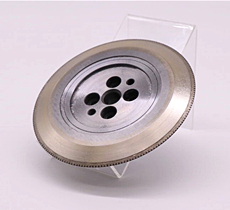
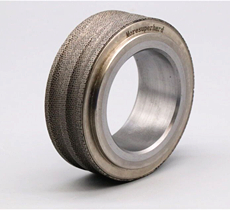
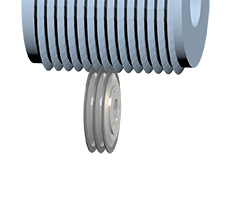
Silicon nitride (Si₃N₄) ceramic ball bearings have emerged as critical components in modern high-end equipment, revolutionizing performance capabilities across aerospace, high-speed machine tools, and advanced mechanical systems. These exceptional components, with their low density, high hardness, and outstanding high-temperature resistance, enable reliable operation in extreme operating conditions where traditional steel bearings cannot perform. However, the exceptional properties that make silicon nitride ceramic balls so valuable also create significant manufacturing challenges, making precision grinding processes essential for producing bearing-grade ceramic balls that meet stringent quality requirements.
The Strategic Importance of Silicon Nitride Ceramic Bearings in Modern Industry
Silicon nitride ceramic balls represent a technological breakthrough in bearing technology, offering performance characteristics that far exceed conventional steel bearings. With a density of approximately only 40% that of bearing steel, yet hardness approaching that of steel and superior high-temperature and corrosion resistance, these ceramic balls enable unprecedented performance in demanding applications.
The unique combination of properties makes silicon nitride ceramic bearings indispensable in:
- Aerospace Engine Components: Operating reliably in high-temperature, high-speed environments where traditional bearings fail
- High-Speed Electric Spindles: Enabling rotational speeds exceeding steel bearing limitations while maintaining dimensional stability
- Petrochemical Machinery: Providing corrosion resistance in aggressive chemical environments while withstanding extreme operating temperatures
- Medical Device Applications: Offering biocompatibility and superior wear resistance for precision medical equipment
- Automotive High-Performance Systems: Delivering enhanced performance in racing and high-performance automotive applications
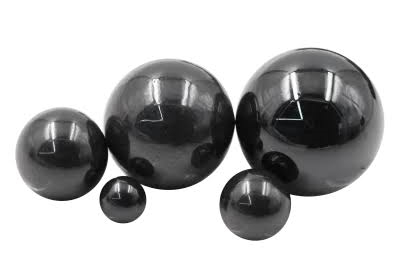
These critical applications demand ceramic balls that meet exacting standards for dimensional accuracy, sphericity, and surface quality—requirements that create significant manufacturing challenges due to the material's exceptional hardness and brittleness.
The Dual Challenge: Exceptional Hardness and Inherent Brittleness
Silicon nitride ceramics present a formidable manufacturing paradox: they are both exceptionally hard (HV1500-1700) and inherently brittle. This dual characteristic creates significant processing challenges:
- Material Hardness: The extreme hardness (HV1500-1700) makes conventional abrasives virtually ineffective, requiring diamond—the hardest known natural material—for effective material removal
- Brittleness Concerns: Low toughness and high brittleness create risks of surface damage, micro-cracking, and even catastrophic failure during processing
- Quality Requirements: Bearing-grade applications demand dimensional accuracy within micrometers, sphericity to G2-G5 standards, and surface roughness (Ra) values that meet precise specifications
- Efficiency Pressures: Industrial applications demand cost-effective, high-throughput manufacturing processes that can produce quality ceramic balls at commercially viable rates
The intersection of these challenges creates a complex manufacturing environment where process selection, tool specification, and parameter optimization become critical factors in achieving commercial success.
Diamond Grinding Wheels: The Indispensable Processing Solution
In the realm of silicon nitride ceramic ball manufacturing, diamond grinding wheels have emerged as the cornerstone technology enabling efficient, high-quality processing. The selection of appropriate grinding wheel specifications represents the critical difference between successful production and costly failures.
Why Diamond is Essential for Ceramic Processing
The fundamental principle of abrasive machining requires that the abrasive material be harder than the workpiece material. With silicon nitride's hardness exceeding HV1500, only two abrasive materials possess sufficient hardness for effective cutting:
- Diamond (HV8000-10000): The hardest known natural material, capable of effectively cutting silicon nitride ceramics
- Cubic Boron Nitride (CBN) (HV ~4500): While hard enough for some ceramics, CBN undergoes chemical reactions with iron-group elements at elevated temperatures, limiting its application in ceramic processing
This hardness hierarchy makes diamond the practical choice for silicon nitride ceramic processing. However, the implementation of diamond abrasive technology requires careful consideration of bond systems, particle sizes, and wheel geometry to achieve optimal results.
Two-Stage Processing Strategy: Balancing Efficiency and Precision
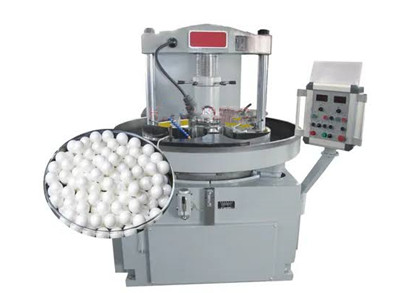
Successful silicon nitride ceramic ball manufacturing typically employs a two-stage processing approach, with each stage requiring distinct wheel specifications and operating parameters to optimize either efficiency or precision.
Stage 1: Rough Grinding - The Efficiency Revolution
The rough grinding stage focuses on rapid material removal and establishing basic sphericity, preparing ceramic ball blanks for precision finishing operations. This stage represents the most significant opportunity for productivity improvement through proper wheel selection and process optimization.
Traditional Approaches and Limitations
Conventional rough grinding methods using cast iron plates with loose abrasives (diamond powder or boron carbide) suffer from significant limitations:
- Extremely Low Efficiency: Processing times measured in hours per individual ceramic ball
- Quality Defects: Frequent occurrence of surface defects including pits, ring patterns, and ball breakage
- Inconsistent Results: Unpredictable processing outcomes creating quality control challenges
- High Labor Requirements: Intensive manual intervention and supervision requirements
The Bonded Abrasive Revolution
The introduction of bonded diamond grinding wheels has revolutionized rough grinding efficiency. By fixing diamond abrasive particles in a bond matrix, bonded wheels effectively create "thousands of micro cutting tools" continuously engaged in material removal, delivering material removal efficiency 5-8 times higher than traditional loose abrasive methods.
Performance improvements demonstrated with 4.7625mm diameter silicon nitride ceramic balls include:
- Dramatically reduced processing times
- Elimination of common surface defects
- Reduced labor intensity through automated processing
- Consistent quality across production batches
Optimal Wheel Specifications for Rough Grinding
The rough grinding stage prioritizes high material removal rates, wheel sharpness, and self-sharpening characteristics. Ceramic bond systems represent the optimal choice for this application:
- Ceramic Bond Advantages: Brittle bond characteristics fracture along grain boundaries during grinding, causing dull abrasive particles to detach and continuously expose fresh, sharp cutting edges
- Performance Benefits: High grinding capability, low temperature rise, sustained sharpness, and exceptional grinding efficiency
- Efficiency Focus: While ceramic bonds exhibit lower impact resistance compared to metal bonds, their efficiency advantages far outweigh this limitation in rough grinding applications
Stage 2: Precision Finishing - The Guardian of Accuracy
After rough grinding, ceramic balls have achieved basic sphericity but require precision finishing to meet bearing-grade specifications. The finishing stage focuses on achieving dimensional accuracy within G2-G5 standards (GB/T308.1), requiring precise control over diameter variation, sphericity error, and surface roughness.
The Transition from "Strongman" to "Sculptor"
In the finishing stage, the processing tool's role transforms from high-efficiency material removal to precision surface generation. Material removal amounts become minimal (micrometer level), but control over surface quality and sphericity must be extremely precise.
Resin Bond Systems for Precision Finishing
Resin bond bonded abrasive tools dominate the precision finishing stage due to their unique characteristics:
- Elastic Bond Properties: Phenolic resin and other organic bonds provide elasticity that enables uniform cutting depth and minimal surface damage
- Auxiliary Additives: Addition of chromium oxide, green silicon carbide, and other auxiliary materials improves grinding performance and heat dissipation
- "Grinding Replaces Lapping" Capabilities: Achieves precision finishing results that eliminate the need for separate lapping operations
Performance Achievements
Advanced finishing products, such as those developed by Shandong Guangyida Company, utilize phenolic resin bonds with 1000-5000 mesh diamond powder and specialized auxiliary additives to achieve ceramic ball precision meeting G2 international standards. These products have undergone technical achievement evaluation and been recognized as achieving "international leading level overall technology."
Two-Stage Processing Summary
| Processing Stage |
Role Positioning |
Core Requirements |
Recommended Bond |
Selection Rationale |
| Rough Grinding |
High-Efficiency Removal |
Efficiency, Sharpness |
Ceramic Bond |
Excellent self-sharpening, high grinding efficiency, low temperature rise |
| Precision Finishing |
Precision Shaping |
Precision, Surface Quality |
Resin Bond |
Elastic grinding, minimal surface damage, high precision |
The Indispensable Role of Bonded Diamond Abrasive Tools
In silicon nitride ceramic ball grinding processes, bonded diamond abrasive tools occupy a position best described as "indispensable." This characterization is neither exaggeration nor marketing hyperbole but rather reflects the fundamental requirements imposed by material properties and processing principles.
The Hardness Threshold Effect
The basic principle of abrasive machining requires abrasive materials harder than workpiece materials. With silicon nitride ceramics achieving hardness values exceeding HV1500, diamond's exceptional hardness (HV8000-10000) makes it the practical choice. While CBN possesses sufficient hardness for some applications, its chemical reactivity with iron-group elements at elevated temperatures limits its utility in ceramic processing.
Comprehensive Advantages of Bonded vs. Loose Abrasives
While loose abrasive lapping can process ceramic balls, inherent limitations include:
- Low processing efficiency
- Poor abrasive utilization rates
- Significant quality variation
Bonded tools firmly hold abrasive particles within the bond matrix, delivering:
- High abrasive utilization rates
- Stable processing conditions
- Continuous automated processing capability when paired with appropriate grinding fluids
The industry trend toward "grinding replacing lapping" represents a technological upgrade direction for ceramic ball processing.
The Bridge Between Material and Precision
Without bonded superhard abrasive tools, efficient precision processing of silicon nitride ceramic balls lacks viable implementation paths. Whether ceramic bond products for rough grinding or resin bond products for precision finishing, the core value lies in transforming diamond superhard characteristics' "potential" into stable, controllable industrial "production capacity."
Grinding Wheel Selection Criteria: The Foundation of Process Success
Proper grinding wheel selection represents a critical element in ceramic ball grinding process design. Inappropriate selection leads to reduced efficiency, unachieved precision standards, accelerated tool wear, or workpiece damage. Selection requires comprehensive decision-making based on processing stage (rough grinding/finishing) and process requirements.
Bond Type: The First Decision Factor
Three primary bond types offer distinct characteristics requiring balanced selection based on processing objectives:
Ceramic Bond – Rough Grinding First Choice
- Core Advantages: High self-sharpening capability and sharpness. Ceramic bond brittleness causes fracture along grain boundaries during grinding, enabling timely detachment of dull abrasive particles and continuous exposure of fresh cutting edges
- Performance Characteristics: Strong grinding capability, low grinding temperature, sustained sharpness, high grinding efficiency
- Limitations: Higher brittleness with lower impact resistance compared to metal bonds
- Application Rationale: In rough grinding scenarios prioritizing efficiency, advantages far outweigh limitations, making ceramic bonds the optimal efficiency solution
Resin Bond – Finishing First Choice
- Core Advantages: Phenolic resin and other organic bonds provide elasticity and self-sharpening capabilities with uniform cutting depth and minimal surface damage
- Auxiliary Materials: Addition of chromium oxide, green silicon carbide, and other auxiliary materials improves grinding performance and heat dissipation
- Limitations: Poor heat resistance and faster wear rates
- Application Rationale: Surface quality advantages make resin bonds indispensable in finishing operations despite limitations
Metal Bond – Specific Application Scenarios
- Characteristics: Strongest diamond particle holding force, best wear resistance, high thermal conductivity, enabling shape stability under heavy loads
- Critical Limitation: Poor self-sharpening—dull abrasive particles cannot automatically detach, creating lowest grinding efficiency among bond types
- Application: Generally not the first choice for efficiency-focused rough grinding, more applicable to form grinding scenarios requiring extreme wheel shape stability
Abrasive Particle Size: Determining Surface Quality
Abrasive particle size directly determines processing surface roughness and material removal efficiency, creating an inherent trade-off relationship.
Rough Grinding: Selection of coarser particle sizes (e.g., 80#-200#) diamond abrasive particles pursues high material removal rates. Coarse particle sizes enable deep cutting depth and strong cutting forces, suitable for rapid removal of sintered blank material. Combined with ceramic bond's high self-sharpening capability, optimal rough grinding efficiency is achieved.
Finishing: Selection of micro-powder level diamond (e.g., 1000-5000 mesh, corresponding to approximately 2.6-13μm particle size). Finer abrasive particles create lower processing surface roughness but reduced efficiency. Finishing requires balancing efficiency and precision, typically employing multiple processing stages with progressively finer particle sizes.
Grinding Wheel Diameter and Working Face Width: Efficiency and Uniformity Assurance
Traditional foreign products feature diameters of only 200-300mm with narrow working faces, limiting processing efficiency. Domestic enterprises have developed large-diameter, ultra-wide ring technology solutions to address this limitation.
Typical Parameters: Grinding wheel diameter 800-1000mm, ring-end working face radial width 200-240mm.
Technical Advantages:
- Large diameters enable high linear speeds and improved processing efficiency
- Wide working faces create longer contact trajectories between tool and ball blanks, improving ball sphericity and dimensional consistency
- This technological breakthrough enables mass production precision processing of silicon nitride ceramic balls
Abrasive Concentration and Porosity
Abrasive Concentration: Refers to diamond volume percentage within the bond matrix. Finishing product concentration typically controlled at 75%-200% (diamond volume representing 18.75%-50% of grinding body). Excessively high concentrations cause excessive cutting forces and surface damage; excessively low concentrations result in insufficient efficiency.
Porosity: Affects chip evacuation and cooling effects. Both rough grinding and finishing tool porosity should be controlled below 5% to ensure strength and abrasive particle holding force. Processing heat dissipation and chip evacuation issues are primarily addressed through proper grinding fluid selection, such as adding polar organic compounds to grinding fluids to mitigate wheel loading.
Conclusion: Optimizing Silicon Nitride Ceramic Ball Manufacturing
Bonded diamond abrasive tools play a core role throughout silicon nitride ceramic ball grinding processes, from rough grinding through precision finishing, occupying an irreplaceable position. Rough grinding stages should prioritize ceramic bond, coarser particle size products to fully leverage efficiency advantages from high self-sharpening and sharpness characteristics. Finishing stages should employ resin bond, micro-powder particle size products to ensure G2-level precision.
The core selection logic involves: bond types determining processing methods (ceramic bonds pursuing efficiency, resin bonds pursuing precision, metal bonds for special applications), particle sizes determining surface quality, and wheel dimensions determining production efficiency. Proper matching of these three elements represents the technical key to achieving high-quality, high-efficiency silicon nitride ceramic ball processing.
With continued promotion of "grinding replacing lapping" processes, specialization, large-scale development, and precision enhancement of these processing tools will become mainstream trends in bearing industry ceramic ball processing. Manufacturers who understand and implement these advanced grinding solutions will be positioned for success in the demanding global ceramic bearing market, delivering the exceptional performance characteristics that silicon nitride ceramic bearings promise across diverse high-performance applications.