NEWS
19
Oct

Diamond Double Disc Wheels That Hold Flatness to 0.20 µm

Share:

Why Tungsten Carbide Seal Rings Are One of the Hardest Flat Parts to Grind


Mechanical seal rings made of tungsten carbide (WC-Co) are found in pumps, compressors, agitators, and rotary equipment across oil and gas, chemical, food, pharmaceutical, and water industries. The seal faces must be perfectly flat and mirror-smooth—any waviness, chip, or scratch breaks the seal and causes leakage. But tungsten carbide is among the hardest commercial materials (HRA 90+), extremely brittle, and prone to edge chipping during conventional grinding. Aluminum-oxide and silicon-carbide wheels dull almost immediately; resin-bonded conventional wheels cannot hold flatness across a production batch. The result is low throughput, high scrap, and frequent wheel changes. The proven solution is a resin- or metal-bond diamond double-disc wheel running on a high-precision double-disc fine-grinding machine—typically Peter Wolters, Lapmaster, Diskus, or similar.


The MORESUPERHARD Case: WC Seal Rings on a Peter Wolters Machine


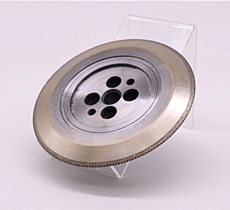
A typical customer case illustrates what the right diamond disc achieves. The workpiece was tungsten-carbide mechanical seal rings running on a Peter Wolters high-precision double-disc fine-grinding machine. The MORESUPERHARD solution was a 2A2T resin-bond diamond double-disc wheel of size ø720 mm × 30 segments × 5 mm rim × 320 mm inner diameter, paired with custom dressing stones to maintain the disc face. The results met every target the seal manufacturer had been chasing for years:

Metric Result Why It Matters
Material removal rate 70 µm/min High stock removal without thermal damage to carbide
Cycle time per batch 2 min 30 s Short enough for mass production of seal rings
Surface finish Ra 0.20 µm Mirror face required for mechanical seal contact
Flatness Micrometer-level (sub-µm across the ring face) Critical for seal leakage performance
Wheel life >1,000,000 workpieces (on 25×25 mm HSS/carbide parts) Very low cost per part over production life


Why the 2A2T Diamond Disc Design Wins on Carbide


The 2A2T designation refers to a segmented double-disc wheel with resin bond and diamond abrasive. Segmented construction matters for three reasons. First, the gaps between segments act as chip-evacuation channels and coolant passages, preventing loading on the hard carbide workpiece. Second, segmented wheels are easier to dress and true than a full-ring disc. Third, the resin bond cushions the diamond grains so they do not pull out under the brittle load of carbide grinding. The custom dressing stones supplied with the disc keep the segment face flat and open across millions of cycles—without a properly matched dresser, even a great disc will drift out of flatness within weeks.


Why Double Disc Grinding Beats Surface Grinding for Seal Rings


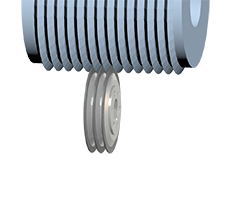
A seal ring must be flat and parallel on both faces simultaneously—because the two faces run against mating seal surfaces, any non-parallelism creates uneven contact and leakage. Single-sided surface grinding grinds one face at a time, and re-fixturing the ring to flip it introduces alignment error that limits parallelism to several micrometers. Double disc grinding grinds both faces at once between two opposing wheels, holding parallelism naturally because the part never leaves the carrier. Cycle time is also far shorter: a batch of seal rings finishes in 2–3 minutes rather than the 20–30 minutes typical of sequential surface grinding. For a part where both faces must be within sub-micron flatness, double disc grinding is not just faster—it is the only process that can hold the spec reliably at production volume.


Flatness Requirements by Seal Application


Seal Application Typical Flatness Requirement Surface Finish
Water pumps / general industrial seals ~1–3 µm across the seal face Ra 0.2–0.4 µm
Oil and gas mechanical seals <1 µm across the seal face Ra 0.1–0.2 µm
High-speed compressor seals Sub-micron, low waviness Ra 0.1 µm or better
Semiconductor / chemical seals Sub-micron, no radial scratches Ra 0.05–0.1 µm


The diamond double-disc process described in our case study—2A2T segmented wheel on a Peter Wolters machine—delivers flatness well under one micrometer and Ra 0.20 µm, covering all but the most demanding semiconductor seal applications. For sub-0.1 µm finishes, a final lapping step with fine-grit diamond plates is added.


How to Specify the Right Diamond Disc


When requesting a disc quote, the following information lets us match the bond, grit, segment pattern, and dressing stones to your job: workpiece material (WC-Co grade, silicon carbide, carbon, HSS), part size and thickness, stock removal per face, target flatness and Ra, machine brand and model (Peter Wolters, Lapmaster, Diskus, Gardner, Giustina, etc.), disc diameter and bore, and expected annual volume. Without these details, a generic diamond disc will either wear too fast or underperform on removal rate—both cost more than the right disc in the first place.


Beyond Seal Rings: Where the Same Disc Family Works


The same diamond double-disc technology serves any hard, brittle, flat component where both parallel faces must be ground simultaneously to sub-micron flatness:
  • Mechanical seal rings (tungsten carbide, silicon carbide, carbon graphite).
  • Industrial blades and knife blanks (carbide-tipped, high-speed steel).
  • Ceramic valve plates and ceramic substrates.
  • Carbide inserts and tool blanks.
  • Magnetic materials, ferrite cores, and engineering ceramics.
For ferrous hardened parts—bearing rings, piston rings, connecting rods—the same double-disc geometry is supplied with CBN abrasive instead of diamond. The bond, segment pattern, and dressing system are matched to the workpiece material.


Cost per Part Is the Right Benchmark


Shops comparing diamond double-disc wheels often focus on the disc price per piece. The right benchmark is cost per finished seal face. A disc that removes 70 µm/min, holds Ra 0.20 µm and sub-micron flatness across a 2.30-minute batch, and runs for over a million workpieces before replacement delivers far lower cost per part than a cheaper conventional wheel that changes weekly and scraps 5–10% of seal rings. When you request a quote, give your workpiece material, size, target flatness and Ra, machine brand, and expected annual volume—we will size the disc and dressing system to your real cost-per-part target.


We Supply Diamond Double-Disc Wheels and Dressing Stones


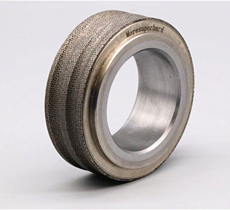
MORESUPERHARD manufactures resin- and metal-bond diamond and CBN double-disc grinding wheels for Peter Wolters, Lapmaster, Diskus, Gardner, Giustina, and similar double-disc machines. Discs are available as full-ring or segmented (2A2T style), with custom grit, concentration, segment pattern, and mounting bore—paired with matched diamond dressing stones. Send us your workpiece drawings, machine model, and target specs; we will recommend the right disc and dressing package.


Frequently Asked Questions


Q: Can diamond double-disc wheels grind tungsten carbide seal rings?
A: Yes. Resin-bond diamond double-disc wheels (2A2T segmented style) are the standard for grinding tungsten-carbide and silicon-carbide seal rings to sub-micron flatness and Ra 0.20 µm on high-precision double-disc machines such as Peter Wolters.

Q: What surface finish can be achieved on carbide seal rings?

A: With the right diamond disc and dressing cycle, seal rings reach Ra 0.20 µm or better and micrometer-level flatness—sufficient for mechanical seal face contact and leak-tight service.

Q: How long does a diamond double-disc wheel last?

A: In production grinding of 25×25 mm high-speed steel and carbide parts, a well-maintained disc exceeded 1,000,000 workpieces. Life depends on workpiece material, stock removal, dress cycle, and machine condition.

Q: Peter Wolters vs Lapmaster vs Diskus—can you supply replacement discs?

A: Yes. We manufacture replacement diamond and CBN double-disc wheels for Peter Wolters, Lapmaster, Diskus, Gardner, Giustina, and similar machines, with custom bore, segment pattern, and mounting geometry matched to your machine.

Q: Why use a segmented 2A2T disc instead of a full ring?

A: Segment gaps act as chip and coolant channels, prevent loading on brittle carbide, simplify dressing, and distribute wear evenly. For hard-brittle materials the segmented design is almost always preferred.

Q: Do you supply the dressing stones too?

A: Yes. Discs are supplied paired with matched diamond dressing stones so the disc face stays flat and open across production. Mismatched dressing is the most common cause of premature disc wear.
 
FOLLOW US
This Blog keeps our valued customers informed of important Radiac News and Events, and in the industries we serve.
Copyright © 2003-2023 More SuperHard Products Co., Ltd
Home
Whatsapp
E-mail
Inquiry