NEWS
09
Oct

Ball Screws & Planetary Roller Screws for Humanoid Robots: Machining Guide

Share:


Why Screws Are the Heart of Humanoid Robot Linear Joints


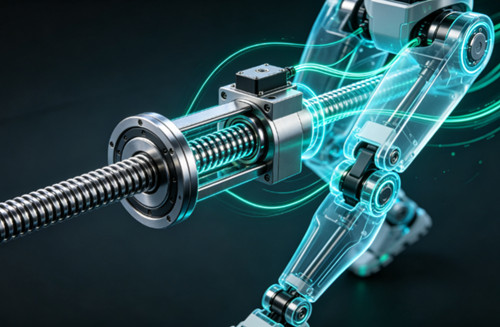
In every humanoid robot, the screw is the core transmission part that turns the motor’s rotary motion into the precise linear motion of the joint. It is the physical basis for crouching, walking, grasping, and every other complex movement the robot performs. Based on a public teardown of Tesla’s Optimus humanoid, screws account for about 9% of total BOM cost—making them one of the highest-value single categories in the robot. The Optimus Gen generation carries 14 planetary roller screws in its heavy-duty linear joints (hips, knees, waist, upper arms) plus 12 miniature ball screws inside its dexterous hands (six per hand)—26 screw assemblies per robot in total. As humanoid robots move from prototypes to mass production, demand for precision screws is entering a rapid-growth phase, and so is demand for the superabrasive tools that machine them.

                           Ball Screws & Planetary Roller Screws


Three Screw Technologies: Planetary Roller, Ball, and Trapezoidal


   Ball Screws & Planetary Roller Screws

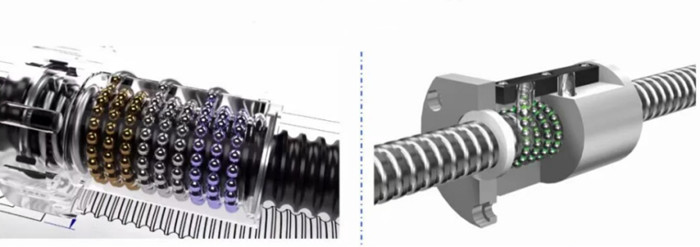
All screws share the same basic structure—a screw shaft, a nut, rolling elements (rollers or balls) and a circulation or retaining mechanism—but they differ dramatically in contact geometry, load capacity, and cost. Choosing the right type—and the right machining process—starts with understanding the three routes:
 
Type Contact Key Pros Best Fit in a Robot
Planetary roller screw Multi-point line contact (rollers spin + orbit) Compact, highest precision, high load, long life, shock-resistant Heavy-duty linear joints: hips, knees, waist, upper arms
Ball screw Point contact through recirculating balls Mature technology, controllable cost, complete supply chain Dexterous hands, moderate-precision positions, supplement to roller screws
Trapezoidal screw Sliding contact Self-locking, simple structure, low cost Low-load auxiliary adjustment only


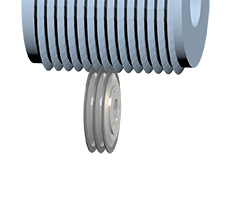
The planetary roller screw is the most technically demanding and highest-performing type. Rollers are evenly distributed around the shaft, each meshing with both the shaft multi-start thread and the nut; as the shaft turns, rollers spin on their own axis while orbiting the shaft, converting rotation into linear motion through multi-point thread engagement. This line contact gives it far higher load capacity and fatigue life than the point contact of a ball screw, which is why it has become the mainstream choice for humanoid linear joints. Ball screws remain dominant in industrial automation and extend to robot positions with moderate load requirements; trapezoidal screws, with their sliding friction and low efficiency, are confined to auxiliary adjustment.


The Machining Challenge: Why Screws Are Hard to Make


The value of a screw lies not just in quantity but in process capability—it is one of the most technically barriered components in precision manufacturing. The production flow is long and demanding, with four categories of high-end equipment required along the way:
  1. Lathes: turning the shaft blank to near-net shape before heat treatment.
  2. Heat-treatment equipment: quenching and tempering the raceways to HRC 58–62 for hardness and fatigue life.
  3. Grinding machines: the critical stage—thread grinding and raceway grinding that determine profile accuracy, surface roughness, and lead error.
  4. Straightening presses: controlling runout after heat treatment and grinding.
After heat treatment, screw blanks reach HRC 58–62, and the raceway profile (arcs for ball screws, multi-start threads for roller screws) must be ground to micrometer accuracy with mirror-like surface finish. This is the stage where conventional abrasive wheels fail fast, burn the surface, and cannot hold profile—and where superabrasive tools become essential.


Why Superabrasive Tools Are Non-Negotiable for Robot Screws


Grinding hardened screw raceways at HRC 58–62 is a superabrasive application. CBN (cubic boron nitride) and diamond tools deliver the hardness, wear resistance, and thermal stability that conventional Al2O3 and SiC wheels cannot match. For screw manufacturers targeting humanoid-robot precision, three tool categories matter most:
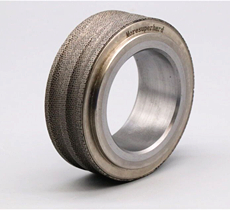
  • CBN grinding wheels: vitrified or resin-bond CBN wheels for thread and raceway grinding of hardened steel screws. They hold profile, run cool, and produce Ra values well below the threshold for smooth, low-friction operation.
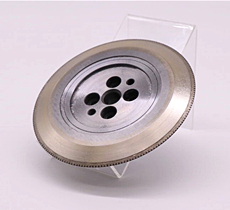
  • Diamond dressing tools & rotary dressers: to true and condition CBN and conventional wheels between cycles, keeping raceway geometry and surface texture consistent across thousands of parts.
  • PCBN turning and whirlwind-milling inserts: for post-heat-treatment hard turning or whirlwind milling of raceways where grinding is being reduced—custom-profiled to each screw raceway rather than bought as standard inserts.
High-precision thread grinders themselves are still dominated by German and Japanese makers and are a key bottleneck for domestic substitution. But even with imported machines, the wheel and dressing tool formulation a manufacturer chooses determines whether they hit cycle time, surface finish, and cost-per-part targets. Optimizing the superabrasive process is the fastest lever available to screw makers today.


The Market Opportunity: From Automotive to Humanoid Robots


Ball screws and roller screws are not new—they have been the backbone of CNC machine tools, industrial robots, and automation lines for decades. What is new is the volume bar being set by humanoid robots. One Optimus-class robot already contains 26 screw assemblies. As multiple automakers and robotics start-ups ramp toward tens of thousands of units, precision screw manufacturers are re-tooling for higher volumes, tighter tolerances, and lower cost per part.
This ramp-up creates a clear chain reaction. Screw makers need to move from small-batch, high-mix production toward stable, repeatable mass output—and the grinding process is where that transition is won or lost. A wheel that holds profile for 20 parts but drifts by part 200 is not good enough for humanoid volumes; a dressing cycle that takes 30 minutes erodes throughput; a surface finish that varies between batches drives up noise, friction, and premature wear in the robot joint. Regions that already mastered industrial screw production—with precision-machining clusters and a strong supply chain—are best positioned to capture this demand. The winners will be those who pair strong manufacturing capability with the right superabrasive grinding and dressing process from day one.


How We Help Screw Makers Compete in the Humanoid Era


MoreSuperHard supplies the superabrasive tooling behind precision screw manufacturing: vitrified and resin-bond CBN grinding wheels for thread and raceway grinding, diamond rotary dressers and single-point dressing pens, and custom-profiled PCBN inserts for hard turning and whirlwind milling of heat-treated ball screws and planetary roller screws. We work with screw makers to match grit, concentration, bond, and profile to their machine, workpiece material, heat-treatment hardness, and target Ra—then support trial grinding through process optimization. Whether you are ramping for humanoid-robot linear joints or upgrading industrial screw production, contact us with your screw drawings, material, and current process. We will help you grind faster, cleaner, and more profitably.


Frequently Asked Questions


Q: How many screws does a humanoid robot use?
A: A typical humanoid such as Tesla’s Optimus Gen uses about 26 screw assemblies: 14 planetary roller screws in heavy linear joints (hips, knees, waist, upper arms) and 12 miniature ball screws in the dexterous hands (six per hand). Screws represent roughly 9% of total BOM cost.

Q: What is the difference between a ball screw and a planetary roller screw?

A: A ball screw uses recirculating balls in point contact; it is mature, lower cost, and widely used in industrial automation. A planetary roller screw uses threaded rollers in multi-point line contact, offering compact size, higher precision, greater load capacity, and longer life—making it the mainstream choice for heavy-duty humanoid robot joints.

Q: Why is trapezoidal screw not used in robot joints?

A: Trapezoidal screws use sliding friction, so they have low efficiency, noticeable wear, and limited precision. They are self-locking, simple, and cheap, which suits low-load auxiliary adjustment—but not high-frequency, high-accuracy joint drive.

Q: What hardness are robot screw raceways?

A: Screw shafts and nuts are heat-treated to roughly HRC 58–62 after machining, giving the raceways the hardness and fatigue life needed for millions of motion cycles. Grinding this hardness requires superabrasive tools—CBN wheels and diamond dressers—rather than conventional abrasives.

Q: What tools are used to grind ball screw raceways?

A: Vitrified or resin-bond CBN grinding wheels are the standard for thread and raceway grinding of hardened steel screws, paired with diamond rotary dressers to keep wheel geometry consistent. PCBN inserts are also used where hard turning or whirlwind milling replaces part of the grinding route.

Q: Why is thread grinding the bottleneck in screw manufacturing?

A: Thread and raceway grinding determines profile accuracy, surface roughness, and lead error—and high-precision thread grinders are still dominated by German and Japanese manufacturers. Choosing the right superabrasive wheel and dressing process on these machines is the fastest way for screw makers to improve yield and cycle time.
 
FOLLOW US
This Blog keeps our valued customers informed of important Radiac News and Events, and in the industries we serve.
Copyright © 2003-2023 More SuperHard Products Co., Ltd
Home
Whatsapp
E-mail
Inquiry