NEWS
18
Aug

Portable Belt Grinding Machine for Chrome-Coated Rollers: A Singapore Case Study on Versatile Surface Finishing Solutions

Share:

Introduction: The Challenge of Chrome-Coated Roller Maintenance


Chrome-coated rollers ranging from 30 to 100mm in diameter are critical components across printing, packaging, film production, converting, and textile industries. These hardened surfaces deliver exceptional wear resistance and low friction, but they require periodic maintenance to maintain dimensional accuracy and surface finish quality. Over time, rollers accumulate surface defects, uneven coating buildup, scoring marks, and wear patterns that directly compromise the quality of the end products they process.

Traditional maintenance approaches using hand-held sanding strips are increasingly inadequate for modern precision requirements. Labor-intensive, inconsistent, and ergonomically poor, sanding strips struggle to deliver the uniform surface finish that today's quality standards demand. For maintenance workshops processing diverse roller inventories across multiple machines, the need for a flexible, powered grinding solution has never been more pressing.
This case study documents how Seal Care (S) Pte Ltd, a leading Singapore-based industrial maintenance and rotating equipment specialist, transitioned from conventional sanding strips to purpose-built portable belt grinding machines supplied by More Superhard, a China-based manufacturer and global exporter of advanced abrasive tools and precision grinding solutions.

                  Portable Belt Grinding Machine for Chrome-Coated Rollers

Understanding the Client: Seal Care Singapore


Seal Care (S) Pte Ltd  is a well-established Singaporean enterprise specializing in rotating equipment maintenance, mechanical seal repair, and precision machining services. Operating from a fully equipped machine shop, the company serves industrial clients across Southeast Asia with a comprehensive range of mechanical services.

Core Service Capabilities:
  • Impeller Dynamic Balancing: Using a 2100mm OD x 4m length balancing machine, Seal Care provides precision balancing services to ISO G6.3 and G2.5 standards, reducing equipment vibration, improving performance, and extending service life.
  • Comprehensive Machine Shop Facilities: Eight lathes with turning capacities ranging from 200mm to 1000mm diameter and up to 4000mm length, supporting shaft repair, sleeve fabrication, boring, drilling, and milling operations.
  • Surface Finishing: Grinding, polishing, and refurbishing of industrial rollers, shafts, and precision components across diverse materials and hardness levels.
  • Rotating Equipment Repair: Complete overhaul and restoration of pumps, compressors, gearboxes, and other rotating machinery.
With this diverse fleet of equipment and a workflow that demands rapid changeover between jobs, Seal Care needed a belt grinding solution that could be deployed across multiple machines rather than permanently dedicated to a single workstation.


The Problem: Why Sanding Strips Were Holding Back Productivity


Before adopting belt grinding machines, Seal Care relied primarily on sanding strips for roller surface maintenance. These narrow abrasive strips, wrapped around or pressed against rotating rollers, had served adequately for years but presented growing limitations as customer quality expectations increased:
Consistency Issues: Hand-held sanding strips cannot maintain uniform contact pressure across the roller surface. Variations in operator technique, grip strength, and fatigue levels translate directly into uneven material removal, resulting in surface finish variations that fail to meet modern specifications.
Abrasive Life Limitations: Narrow strips present a small working surface area, concentrating wear on limited abrasive zones. On hard chrome surfaces measuring 55-70 HRC, strip life is measured in minutes rather than hours, driving up consumable costs and increasing job completion times.
Operator Ergonomics: Maintaining consistent pressure on a sanding strip during extended grinding sessions is physically demanding. Operator fatigue leads to declining quality over the course of a shift, increasing the risk of rework and customer complaints.
Throughput Constraints: The combination of slow material removal rates, frequent strip changes, and manual pressure application means that processing a single roller can take significantly longer than necessary — reducing the number of jobs the workshop can complete per week.


The Solution: Two Belt Grinder Configurations for Different Needs


                                             Chrome-Coated Rollers

Based on Seal Care's diverse equipment fleet and the need for rapid deployment flexibility, More Superhard proposed two complementary belt grinding configurations:


Configuration 1: Tool-Post Mounted Belt Grinder


This compact grinding head transforms any standard lathe into a belt grinding workstation in minutes. The unit mounts directly onto the lathe's tool post, requiring no permanent modification to existing equipment.
Structural Components:
  • Bright red protective housing with upper arc profile and lower straight section — provides debris containment and operator safety
  • Dual black star knobs for belt tension adjustment and structural locking — enables quick belt changes and tension optimization
  • Front-mounted black metal bracket with upper and lower silver metal rollers — guides the abrasive belt along a controlled grinding path
  • Red-brown abrasive belt surface with blue parameter markings (visible P100 grit designation)
  • Black cylindrical installation shaft with visible internal drive components — transfers power from the lathe or independent motor to the belt drive system
Key Advantages for Seal Care:
  • Rapid installation and removal — the unit transfers between machines in under five minutes
  • No permanent modification to any lathe — preserving equipment value and flexibility
  • One grinder serves the entire fleet of eight lathes — minimizing capital investment
  • Suitable for metal rust removal, workpiece polishing, tool sharpening, and roller refurbishment


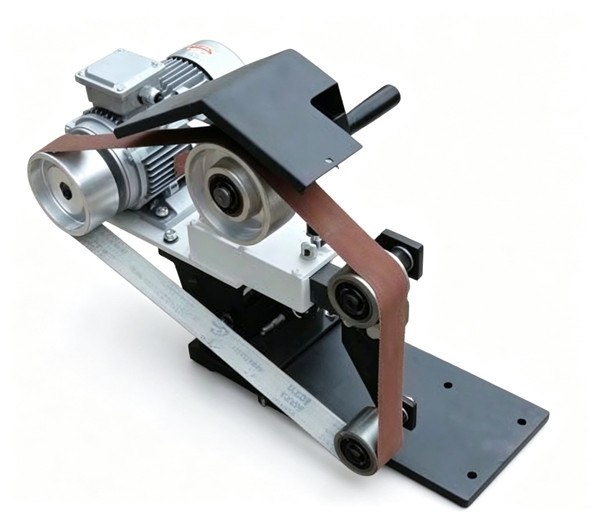
Configuration 2: Base-Mounted Standalone Belt Grinder 


This self-contained unit features its own dedicated motor and base plate, designed for permanent or semi-permanent grinding stations.
Technical Specifications:
  • Overall height: approximately 700mm (confirmed by measurement)
  • Total length (motor to farthest roller): 540mm
  • Motor section height: 400mm
  • Grinding section height: 420mm
  • Motor-to-grinder offset: 360mm from motor end to farthest roller
  • Base plate: 140mm length with four pre-drilled mounting holes for secure workstation fixation
  • Silver-gray aluminum-shell three-phase asynchronous motor with cooling fins and junction box
  • Wine-red protective housing with adjustable tension mechanism
  • Red-brown abrasive belt with multi-roller guidance system
Best Applications:
  • Dedicated deburring stations for incoming and outgoing workpieces
  • Edge sharpening and tool reconditioning
  • Surface preparation before coating or plating operations
  • General-purpose grinding in workshops with available floor space


Seal Care's Decision: Why the Tool-Post Configuration Won


Given Seal Care's operational profile, the company selected the tool-post mounted belt grinder as their primary solution. The decision factors were clear:
  • Multi-machine flexibility: Eight lathes of varying sizes (200mm to 1000mm diameter capacity) mean that dedicating a single grinding station would create bottlenecks. The tool-post grinder follows the work.
  • Job variety: Roller diameters ranging from 30mm to 100mm require different setups. Quick changeover between configurations is essential.
  • Space optimization: Workshop floor space is at a premium in Singapore. Tool-post grinders require zero dedicated floor space when not in use.
  • Capital efficiency: One tool-post unit serves the entire machine fleet, versus the cost of multiple base-mounted units for dedicated stations.


Chrome-Coated Roller Grinding: Technical Best Practices


Grinding chrome-coated surfaces requires specific attention to abrasive selection, belt speed, contact pressure, and thermal management. Chrome coatings typically measure 55-70 HRC hardness and are inherently brittle — excessive force or heat can cause spalling, microcracking, or delamination from the substrate.
Recommended Abrasive Belt Progression:
  • Step 1 — Rough stock removal (P60-P80): Zirconia alumina or ceramic alumina belts for removing heavy buildup, scoring, or dimensional irregularities. Aggressive cutting action with good belt life.
  • Step 2 — Intermediate finishing (P100-P150): Ceramic alumina belts for restoring dimensional accuracy and removing step marks from rough grinding. This stage establishes the baseline surface for final finishing.
  • Step 3 — Fine finishing (P220-P400): Silicon carbide or structured abrasive belts for achieving target Ra values. Essential for rollers used in film, foil, or precision coating applications.
  • Step 4 — Mirror finishing (P600+): Trizact or diamond-impregnated belts for optical-grade or ultra-smooth surfaces required in specialty applications.
Process Parameters for 30-100mm Chrome Rollers:
  • Belt speed: 5-15 m/s — lower speeds for smaller diameters to maintain safe peripheral velocity
  • Contact pressure: Light to moderate — chrome's brittleness demands controlled force to prevent coating damage
  • Coolant: Dry grinding acceptable for light finishing; flood coolant recommended for heavy stock removal to manage thermal load
  • Lathe RPM: 50-200 rpm — ensuring adequate relative surface speed between belt and roller


ROI Analysis: Belt Grinding vs. Sanding Strips


The financial case for transitioning from sanding strips to powered belt grinding is compelling for any workshop processing more than a few rollers per month:
  • Abrasive cost reduction: Belt life is typically 5-10x longer than equivalent sanding strips, reducing consumable spend per job
  • Labor time savings: Powered belt grinding removes material 2-4x faster than manual sanding, reducing job completion time and freeing operators for other tasks
  • Rework reduction: Consistent surface finish quality reduces customer rejections and costly rework cycles
  • Equipment payback: At approximately $350 USD per tool-post grinder unit (tax and shipping included), the investment typically pays for itself within 10-20 jobs


About More Superhard


More Superhard (Henan Moao Superhard Materials Co., Ltd.) is a China-based manufacturer and global exporter specializing in advanced abrasive tools and precision grinding solutions. Headquartered in Henan Province, the company serves industrial clients across more than 60 countries with a comprehensive product portfolio:
  • CBN (Cubic Boron Nitride) grinding wheels for precision machining of hardened steels
  • Diamond grinding wheels for hard and brittle materials including ceramics, glass, and carbide
  • Semiconductor wafer thinning grinding wheels competing with established Japanese manufacturers
  • Portable belt grinding machines and attachments for workshop and on-site maintenance
  • Custom abrasive solutions developed for specialized industrial applications
More Superhard combines deep superabrasive technology expertise with practical understanding of real-world manufacturing challenges. The company's technical sales team works directly with clients to specify the right tool for each application, providing process recommendations, parameter guidance, and ongoing support to ensure optimal results.


Conclusion: A Practical Upgrade with Measurable Returns


The Seal Care case study demonstrates that meaningful productivity improvements do not always require massive capital investment. By transitioning from manual sanding strips to powered belt grinding machines, the company achieved faster job completion, more consistent surface quality, reduced operator fatigue, and the flexibility to deploy grinding capability wherever it is needed across their machine fleet.
For maintenance workshops, manufacturing facilities, and service centers processing chrome-coated rollers, hardened shafts, or other precision cylindrical components, portable belt grinding machines represent one of the highest-ROI equipment upgrades available. Whether you need the multi-machine flexibility of a tool-post mounted grinder or the dedicated performance of a standalone base unit, More Superhard offers configurations tailored to your specific workflow and budget.

Contact More Superhard's technical team for application-specific recommendations, volume pricing, or to discuss custom belt grinding solutions for your unique requirements.

 
FOLLOW US
This Blog keeps our valued customers informed of important Radiac News and Events, and in the industries we serve.
Copyright © 2003-2023 More SuperHard Products Co., Ltd
Home
Whatsapp
E-mail
Inquiry